
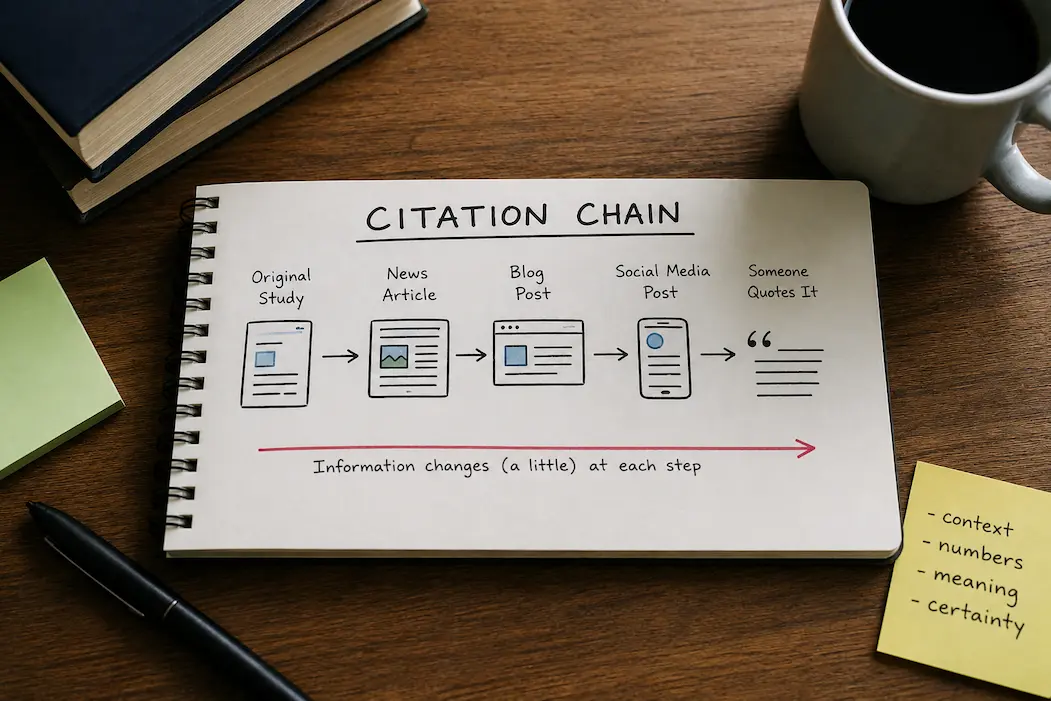
Information rarely stays exactly the same as it moves from one source to another. A research paper may describe a narrow finding, a review may summarize it, a news article may simplify it, and a blog may repeat that summary in stronger language. By the time the idea reaches a social post, important qualifications may have disappeared. Nobody necessarily had to invent anything. A few small changes in wording can turn a limited observation into a broad conclusion. That is why following a citation chain matters: it helps you see not only where a claim came from, but whether its meaning changed along the way.
A citation gives readers a route back to supporting material, but it is not a guarantee that the source supports the exact statement being made. Research examining citation accuracy has found inaccurate references and cases where citation errors were repeated through chains of later publications.
A Citation Is A Starting Point
It is tempting to see a reference at the end of a sentence as proof that the sentence has been verified. But a source can discuss the same topic without supporting the precise claim attached to it. A writer may have relied on a summary instead of the original study, or copied a reference without reading the underlying material. The next writer then cites that article and assumes the work was checked. The reference list becomes longer while the connection between the final wording and the original evidence becomes weaker.
This is why repeated citations can create a false sense of agreement. Five websites may seem to support the same statement, but they could all have taken their information from one article. That article may have relied on one report or study. You then have several repetitions of one source rather than several independent confirmations. Citation tracing helps uncover that difference.
Where Information Starts To Drift
The first change is often harmless: technical language gets simplified. A study might report that two factors were associated under particular conditions. A summary may describe them as “linked.” A later article may say that one factor “affects” the other. Eventually, someone may write that researchers have “proved” the relationship. The topic has remained the same, but the strength of the conclusion has changed.
The small words are often the important ones. Terms such as “may,” “suggests,” “associated with,” and “under these conditions” tell readers how far the evidence goes. When those qualifications disappear, a careful result can sound certain. Research on citation errors has identified inaccurate interpretations and cases where findings were described differently from what the cited source reported.
| Original Source | Later Version | What May Be Lost |
|---|---|---|
| Finding in a specific group | General statement | Scope |
| Association between factors | One factor causes another | Causation |
| Preliminary result | Established fact | Uncertainty |
| Result under certain conditions | Universal result | Limitations |
Simplification is not automatically dishonest. Writers often need to make complicated material readable. The problem begins when the information that is removed is what prevents the claim from being misunderstood.
Secondary Sources Are Useful
Using secondary sources is not wrong. Reviews, news reports, institutional summaries, and explanatory articles can make difficult information accessible. Most readers need them because reading every original study or technical report is unrealistic. The important question is whether the summary is enough for the decision you are making.
For an important claim, it’s worth checking the source. A secondary article tells you how another writer interpreted the evidence. The original material lets you see the research question, scope, findings, and limitations for yourself. Research on citation accuracy has specifically warned against relying blindly on secondary citations and recommends checking the underlying source where possible.
Follow The Chain Backward
A citation chain can usually be followed without specialist tools. Start with the sentence you want to verify and open the cited source. Check whether it supports the statement and whether the wording has become stronger than the evidence. If that source cites an earlier study, report, dataset, or document, follow the reference backward until you reach the original material or the earliest credible source you can identify.
Keep the process simple:
- What exactly does this source say?
- What source is it relying on?
- Has the meaning become broader or more certain?
There is also value in looking sideways instead of staying on one page. Stanford research found that professional fact-checkers were more likely than students and historians to use lateral reading: they left the original website and checked other sources for context.
The Original Source Can Change Your Reading
One of the most useful moments in citation checking is discovering that the original evidence is more limited than the later claim. A blog might say that a study showed a particular behavior “improves” an outcome. You follow the citation and discover that the research only observed an association in a particular sample. The later wording now looks completely unique, even though the citation was based on a real study.
That is why verifying that a source exists is not enough. The important question is whether the source supports the same claim at the same level of certainty. Research has documented real papers being cited in ways that misrepresented their findings or conclusions.
When Several Articles Point To The Same Evidence
Citation chains are also useful for judging apparent consensus. Suppose ten articles repeat the same statistic. That sounds convincing, but the number becomes less impressive if all ten ultimately trace back to one report. Repetition may show that a statistic is popular rather than independently confirmed.
This matters when unusual claims spread widely online. A statement can look established because the same wording appears everywhere. Following references changes the question from “How many sites say this?” to “How many independent sources actually support this?” Those are unique measures.
A Practical Rule For Everyday Use
You do not need to trace every minor fact to its original source. That would make normal reading exhausting. Instead, increase the level of checking according to the importance of the claim. A casual fact may need only a quick look. A statistic you plan to publish, a research finding you intend to explain, or information that could influence an important decision deserves more careful verification.
When you check, focus on the details most likely to change the conclusion: date, population, methodology, comparison, definitions, and limitations. Pay particular attention when a later source sounds much more certain than the original. That is often where the most important information has disappeared.
Conclusion
Data can be manipulated—not necessarily intentionally by anyone. Data can become broader, stronger, or more definitive simply because each author summarizes and rephrases previous research. Original research may be well-defined, yet subsequent summaries retain the core premises while the boundaries become blurred. Readers may encounter seemingly authoritative arguments without realizing how far they have drifted from their original meaning through repeated use.
Therefore, the value of citations lies in their role as pointers, not merely as decoration. If a claim is significant, trace its origins and carefully analyze the wording at every stage. Look for missing conditions, revised definitions, bolder conclusions, and overlooked limitations. You may discover that the ultimate claim is more compelling, or that the original evidence is more limited than the versions circulating online. In both cases, focus on the source, not just on how often it has been repeated.
Frequently Asked Questions
Can citations serve as evidence for an argument?
No. Citations can form a basis for your research, but they must still substantiate your specific points. Research shows that errors in citations and misinterpretations of research findings are common.
Can multiple articles serve as independent evidence?
Not necessarily. Many publications may stem from the same original report or study. By examining the bibliographies, you can determine whether the apparent consensus is truly independent or merely a repetition of the same information.
Do I need to verify the sources?
No. Secondary sources are often useful for casual reading. However, the more important, groundbreaking, controversial, or central your argument is, the more you should verify the sources.

Abdur Rahman is a writer and digital learning enthusiast focused on critical thinking, self-improvement, productivity, and practical online learning strategies. He shares experience-based articles that help readers build useful habits, improve digital skills, evaluate information more effectively, and develop smarter learning systems for everyday life. Through Knowledge Source Hub, his goal is to make learning simpler, more practical, and accessible for everyone.