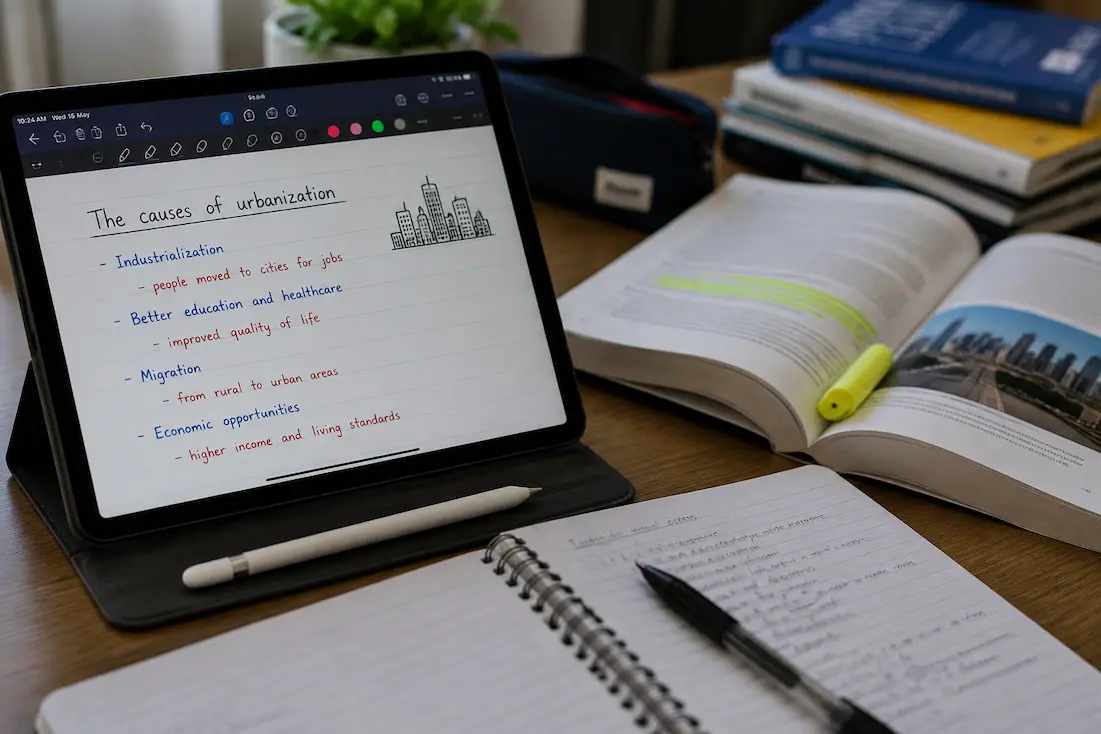
Digital notes are convenient in a way paper notes never quite were. A lecture can be summarized on a laptop, a useful paragraph can be copied into an app, a screenshot can be stored in seconds, and hundreds of pages can sit inside a phone without taking up physical space. I use digital notes myself because they are easy to search, edit, move, and organize. The problem starts when collecting and arranging information begins to feel like learning. It is possible to spend a long time making notes look complete while doing very little to understand or remember what they contain. Good notes should support learning, not become a substitute for it.
This distinction matters because taking notes can give us visible evidence of activity. At the end of a study session, a full page of carefully organized text feels productive. Yet the real question is what remains when the notes are closed. Can you explain the idea without looking at the screen? Can you answer a question about it? Can you use the concept somewhere new? Research on note-taking has long treated it as an important part of learning, but studies also distinguish between taking notes and the learning that results from later processing and retrieval.
When Notes Become A Record Instead Of A Learning Tool
A common problem with digital note-taking is trying to capture everything. Typing is fast, so it becomes easy to record an entire explanation almost word for word. The notes then look thorough, but the act of copying can require less thinking than deciding what matters. When I notice myself trying to preserve every sentence, I know I am probably creating a record rather than building understanding. A useful note should leave something out. It should force a decision about what is important, what needs explanation, and what can safely be ignored.
This becomes especially important when studying from lectures, articles, or videos. The purpose of a note is not to reproduce the source so accurately that you never have to think about it again. The purpose is to create a useful representation that helps you reconstruct the idea later. A 2026 randomized study comparing several note-taking methods found limited differences in later retention across the methods overall, while motivation was more consistently associated with retention. That is a useful reminder that the format of the notes is not the whole learning process. What you do with the information afterward matters greatly.
The Searchable-Notes Trap
Search is one of the biggest advantages of digital notes, but it can also create a false sense of security. If everything is searchable, it feels as though forgetting something is no longer a serious problem. A few words in a search box can bring back a definition, explanation, or quotation that would otherwise be difficult to recall. That is useful for reference work, but it is not the same as knowing the information. A person can become very good at finding an answer inside their own notes without becoming equally good at producing the answer independently.
That difference matters when the goal is learning rather than storage. Retrieval practice research consistently shows that actively trying to recall information can strengthen later retrieval, rather than simply looking at the material again. This suggests a useful change in how digital notes are reviewed. Instead of opening the page and rereading everything, close the notes first and try to reconstruct the important ideas. Then use the notes to check what you remembered correctly, what you missed, and where your understanding is incomplete. The notes become feedback rather than a replacement for thinking.
A Better Digital Note Is Often Shorter
Short notes are not automatically better, but they often force more useful decisions. Imagine learning a concept and saving three paragraphs copied directly from the source. Those paragraphs may preserve the information, but they do not necessarily reveal whether you understood it. Compare that with a few lines written in your own words, followed by one example and one question you still cannot answer. The second note may contain less text while providing more information about your actual understanding.
I find three elements particularly useful for important notes: the idea, the explanation, and the connection. The idea records what the concept is. The explanation puts it into your own words. The connection shows where it relates to something you already know or where you might use it. This makes the note more than a storage container. It becomes a small thinking tool that can help you reconstruct the subject later without returning immediately to the original material.
When Organizing Notes Becomes The Main Activity
Digital note-taking applications make organization almost irresistible. You can create folders, tags, colors, links, templates, icons, databases, and elaborate structures for almost any subject. Some organization is useful, especially when your notes are numerous or you regularly need to retrieve them. But there is a point where organization starts consuming the time that should have been spent learning. You can spend twenty minutes deciding where a note belongs and only five minutes testing whether you remember the idea.
A practical warning sign is when improving the note system feels more satisfying than working with the material. If you keep renaming categories, changing templates, moving notes, or experimenting with another application while rarely testing yourself on what is inside them, the system has become the activity. This is particularly easy to miss because organization produces visible results. The folders look cleaner. The pages look better. The database feels complete. Learning is less visible because its evidence only appears when you can use what you studied without depending entirely on the notes.
Use Notes To Create Questions, Not Just Answers
One change that can make digital notes much more useful is adding questions alongside explanations. Instead of writing only “Retrieval practice strengthens later recall,” for example, you might add, “Why would trying to remember help more than rereading?” or “Where could I apply this idea while studying?” The question creates a reason to return to the note actively. You are no longer looking at a page of finished information. You are giving yourself something to solve.
This fits with the broader evidence for retrieval-based learning. Research has found that practicing retrieval can improve later learning and recall, including when the learner must reconstruct information rather than merely recognize it on the page. Digital notes are particularly well suited to this because they can contain questions, prompts, examples, and self-tests alongside the original explanation. Instead of asking, “How can I make these notes more complete?” a more useful question is, “How can these notes make me think?”
The Difference Between A Useful Archive And A Learning System
A digital archive has a different purpose from a learning system. An archive helps you preserve and retrieve information when you need it. A learning system helps you understand, remember, and apply information. Problems appear when one is mistaken for the other. Keeping a complete record of a subject may be excellent for reference, but it does not guarantee that you can explain the subject without assistance. The notes can remember everything for you while your own memory remains relatively weak.
That does not mean digital notes should be minimal or that you should avoid storing detailed information. Detailed notes can be extremely valuable for research, work, and future reference. The important distinction is what happens between saving and retrieving. For material you genuinely want to learn, include opportunities to recall, explain, compare, and apply it. For information you simply need available later, a well-organized reference note may be perfectly sufficient. Once you separate those purposes, there is much less pressure to make every note perform the same job.
A Simple Way To Review Digital Notes
A useful review session does not have to mean rereading every page. Pick a note, close it, and write or say what you remember. Then reopen it and compare your version with the original. Look specifically for missing ideas, incorrect connections, and areas where you recognized the wording but could not explain the concept yourself. Research on retrieval practice provides strong support for making active recall part of learning rather than relying entirely on repeated exposure to the material.
You can keep the process simple:
- Recall: What do I remember without looking?
- Explain: Can I describe it in my own words?
- Apply: Can I use it in an example?
- Check: What did I misunderstand or forget?
This turns your notes into a testing surface rather than a collection you simply browse. It also exposes weak understanding much faster. A page can look familiar while the underlying idea remains difficult to reproduce. That is precisely the kind of gap active review helps uncover.
Frequently Asked Questions
Will electronic notes hinder learning?
No. Electronic notes are incredibly useful for capturing, organizing, searching for, and evaluating information. The problem arises when note-taking becomes passive copying, or when the notebook itself replaces the act of remembering and applying what has been learned. Research consistently shows that note-taking and technology can enhance learning, but their effectiveness depends on how they are used.
Brief notes or descriptive notes?
That depends on the purpose. Longer notes can be useful for future reference, while shorter notes can help you identify key points and formulate your thoughts in your words. The best approach is to write down the core principles, describe them in your own words, and add examples or questions. Sometimes the best notes aren’t the shortest ones, but rather those that achieve their intended purpose.
Why can I remember the notes but not the subject matter?
This is because it is easier to recognize material than to recall it independently. Familiar language and structure, combined with familiar notes, make the material feel recognizable. Once the notes are out of sight, you may find yourself unable to recall your earlier thoughts. Retrieval practice can help bridge this gap, forcing you to generate knowledge rather than simply remembering it.
Should I categorize my notes?
Categories are only necessary if they facilitate information retrieval. Complex classification systems consume study time. Start with a simple structure and increase the complexity only when you actually encounter a problem retrieving information. If you spend more time managing categories than finding information, the structure is clearly too complex.

Abdur Rahman is a writer and digital learning enthusiast focused on critical thinking, self-improvement, productivity, and practical online learning strategies. He shares experience-based articles that help readers build useful habits, improve digital skills, evaluate information more effectively, and develop smarter learning systems for everyday life. Through Knowledge Source Hub, his goal is to make learning simpler, more practical, and accessible for everyone.