
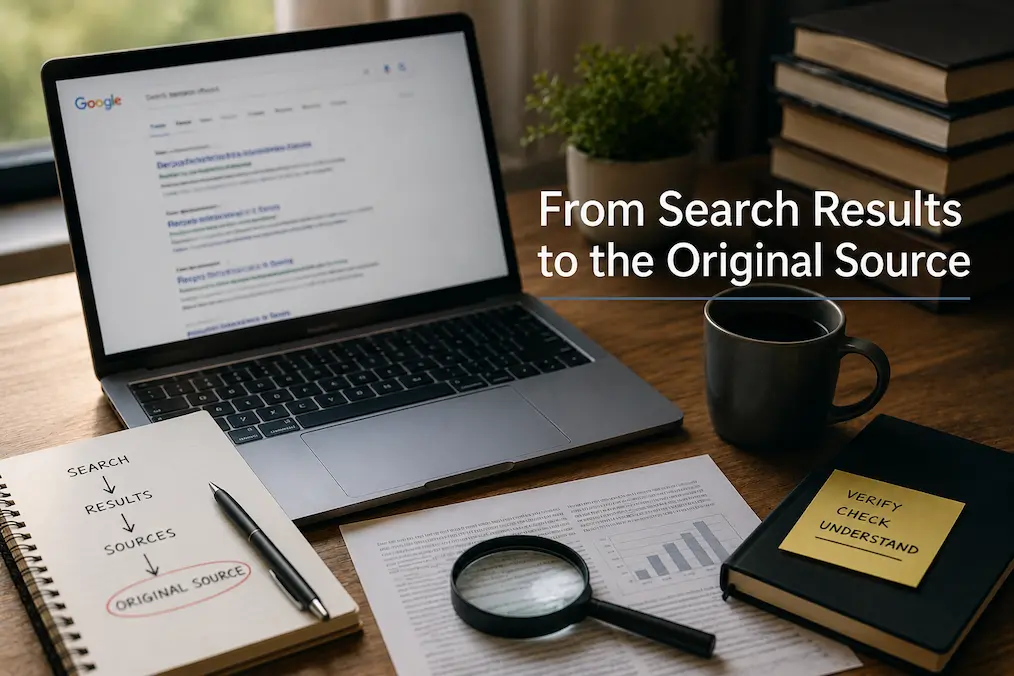
Search engines are excellent at finding information, but search results are not the same as the source. When we type a question into the search bar, we usually get a list of titles, brief descriptions, websites, videos, and other results. Upon seeing the first few results, it is natural to assume they hold the answer—especially if several results seem to convey the same message. However, the information we actually need may require a few extra clicks. A result might simply repeat a claim circulating on multiple websites, summarize research conducted by others, or point to other publications. Obtaining search results is therefore just the beginning of the research process.
This approach is particularly important when a claim is critical and requires verification. A Stanford University study on how people evaluate online content showed that experienced fact-checkers tend to read laterally and seek context beyond the initial page. They also demonstrate “click restraint”—checking the search results before making impulsive choices. The basic strategy applies to general research as well: use search results to identify seemingly plausible sources first, then investigate the information’s actual origin.
Search Results Are Like a Map
Search results are designed to help you locate information, not to verify the accuracy of the content. They may include original reports, summaries, commentary, business pages, or content repurposed from other sources. Titles can also create discrepancies between expectations and the actual page content. This is especially true for complicated subjects, where original information is often boiled down to short summaries.
Therefore, a better approach is not to ask, “Which result should I believe?” but rather, “What type of source does this result point to?” The same set of search results might include government reports, university publications, original research, corporate documents, news articles, and personal blogs, yet their purposes differ fundamentally. Stanford University’s online reading guide recommends a “lateral reading” approach—examining how other sources evaluate the content—rather than judging reliability solely based on the appearance of a single page. Search engines present you with options, whereas the actual sources of information provide the material needed for analysis.
The First Result Is Not Always the Best Result
People often assume that the highest-ranked search result is the most reliable. However, ranking systems are based on many factors, and visibility does not equate to authority. Stanford researchers point out that some novice readers click immediately on the top-ranked results without first checking what other information sources are available. Professional fact-checkers are more cautious when clicking on search results and use additional searches to establish context.
This does not mean, however, that lower-ranked results are necessarily better, or that search engines are useless. It simply means that judgment should not be replaced by ranking. For instance, if you are researching a technical topic, an official documentation page might be more useful, even if a general article ranks higher. If you want to verify a scientific claim, original research or statements from authoritative institutions are more valuable than blog posts that merely repeat the findings. Search results offer you choices; you still need to determine which one comes closest to the evidence you are actually seeking.
Tracing the Source Back to the Source
One of the most valuable research habits is reading the references. Suppose you see an article stating that a study has drawn significant conclusions. Don’t stop there; look up the study itself. If the article cites a government report, open the report and examine it. If a website quotes researchers’ opinions, try to find the original interviews, articles, speeches, or publications. This practice is known as “reading laterally” (or “reading sources”), as explained by Stanford University’s digital literacy tool: “When you find information that has been summarized or paraphrased, you should click on hyperlinks and references to read the source.”
This often changes your perception of a claim. The summary might be accurate, but it may fail to include the study’s limitations, sample size, the date of the information, or the exact circumstances under which the results were observed. Reading the sources allows you to see these details for yourself. You do not need to consult every citation for every trivial fact; however, the more you need to understand a claim, the more useful this habit becomes.
Look for Arguments, Not Just Topics
The broader your search, the more information you will find. Searching for “memory learning” might yield thousands of pages answering completely unrelated questions. It is best to enter the exact argument you wish to investigate into your search query. When a document cites a specific study that found a correlation between two factors, search Google for specific phrases from the argument, the study’s title, and the names of the researchers or institutions associated with the study. This way, you can easily locate the original source, as you no longer need to search through the entire topic but can focus on specific information. Quotation marks can also be helpful when dealing with distinctive wording, enabling you to effectively find the exact phrases used. A Stanford University study on online evaluations found that effective evaluators employ targeted search strategies rather than aimlessly clicking through search results. Detailed searches are often essential for finding alternative summaries or uncovering the underlying original material.
Compare the Text at Every Step
Simply tracing the source is not enough; you must also compare the factual claims made by each source. A news report might state that researchers found a correlation, while another website claims the research demonstrates that one factor caused the other. The topic is the same, but the strength of the claims differs. Sound research methods bring these differences to light rather than treating all variations as interchangeable.
Pay attention to subtle nuances. Words such as “possibly,” “suggest,” “related to,” “might,” “preliminary,” “under,” and “under certain conditions” can indicate limitations in the conclusions drawn. In short, when these crucial elements are missing, a claim that initially appears irrefutable may actually be the result of a thorough investigation. This is one reason why returning to the original content is so important: you are not merely looking for the same topic; you are verifying whether subsequent interpretations still align with the original evidence.
A Simple Search-To-Source Method
When I need to investigate something properly, I find it useful to move through the process in stages rather than opening every result at once. Start with the search results and identify two or three potentially useful pages. Determine which one appears closest to the original evidence, then inspect its references or links. From there, move toward the earliest credible source you can reasonably identify. Once you reach that source, compare its actual wording and conclusions with the claim that started your search.
The process can be summarized like this:
Search result → relevant page → cited source → original material → comparison and context
At each stage, ask:
- Who created this information?
- Where did they get it?
- What exactly does the original source say?
- Has anything important been removed or exaggerated?
This method is deliberately simple. It is not a research procedure that needs specialized software. It is a way of resisting the natural temptation to stop once you find a page that sounds convincing.
Knowing When To Stop Digging
There is also a point where research becomes excessive. Not every fact needs a ten-source investigation, and spending thirty minutes tracing the origin of an insignificant detail can be less useful than moving on. The depth of verification should depend on the importance of the information. If you are satisfying casual curiosity, a reliable summary may be enough. If you are publishing a statistic, making an important argument, or relying on information for a significant decision, going closer to the original source is much more worthwhile.
This balance is important because good research is not about clicking as many sources as possible. It is about finding enough reliable evidence to answer the actual question. Stanford’s digital-strength guidance recommends lateral reading and deliberate search behavior precisely because the goal is better evaluation, not simply more browsing. Once you have reached a credible source, understood its evidence, checked the important limitations, and confirmed that the claim matches the source, additional searching may add little value.
Frequently Asked Questions
Is The First Search Result Usually The Most Reliable?
Not necessarily. Search ranking and source reliability are different questions. A high-ranking page may be useful, but you should still consider who produced it, what evidence it uses, and whether a more authoritative or original source exists. Stanford’s research on online information evaluation found that professional fact-checkers were more careful about choosing which search results to pursue rather than automatically selecting prominent results.
What Does “Original Source” Mean?
It depends on the claim. For a research finding, it may be the original research paper. For a government statistic, it may be the agency’s report or dataset. For a quotation, it may be the original interview or speech. For a company statement, it may be the company’s own announcement or documentation. The useful idea is to move as close as reasonably possible to the source that produced the information rather than relying entirely on later summaries.
Should I Open Several Search Results?
Occasionally. Opening a few results can help you compare explanations and identify where they got their information. But the goal is not to collect dozens of similar pages. It is to determine which sources are independent and which are repeating the same material. Once you identify the original or strongest evidence, spending more time on repetitive summaries may not provide much additional value.
Why Should I Follow Links Inside An Article?
Following references can show where an important claim came from and whether the article has represented the original information accurately. Stanford’s digital-literacy guidance specifically describes “reading upstream” as following references or hyperlinks to examine the sources behind summarized information. This is especially useful when the article makes a strong claim based on research, statistics, or official information.
Conclusion
Search engines have made finding information remarkably easy, but they have not removed the need to investigate what we find. A search result can lead to a useful source, but it can also lead to a summary of a summary of something published elsewhere. The closer important information gets to its source, the easier it becomes to see its actual scope, wording, evidence, and limitations. That is why searching and researching should be treated as two related but different activities.
The next time an online claim really matters, resist the urge to stop at the first convincing result. Use the search engine to locate possible sources, examine who created them, follow their references, and compare the final claim with the original material. You do not have to investigate everything this way. But when accuracy matters, moving from the search result to the source behind the source can turn a quick answer into a much more reliable understanding.

Abdur Rahman is a writer and digital learning enthusiast focused on critical thinking, self-improvement, productivity, and practical online learning strategies. He shares experience-based articles that help readers build useful habits, improve digital skills, evaluate information more effectively, and develop smarter learning systems for everyday life. Through Knowledge Source Hub, his goal is to make learning simpler, more practical, and accessible for everyone.