
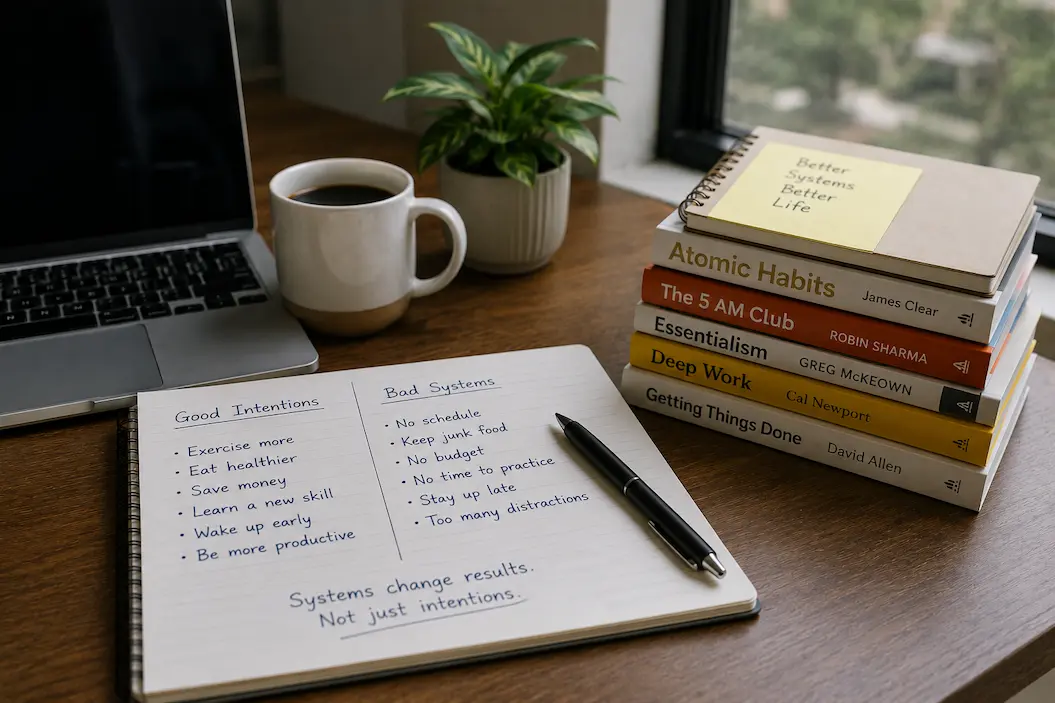
Repeatedly failing at something can be incredibly frustrating. You resolve to study regularly, exercise three times a week, read more, get your finances in order, cut down on phone usage, or finally finish that project that has been sitting on the shelf for months. Your intentions are genuine. You might even feel highly motivated after making that resolution. Yet, a few days later, you are back to square one. You might quickly assume the problem is a lack of self-discipline. But the issue may not lie with the person themselves; rather, the framework built around that goal is poorly designed. The goal itself might be reasonable, but the daily routine surrounding it makes success exceptionally difficult.
This distinction has changed my perspective on various daily goals. I used to view repeated failure as proof that someone needed more motivation. But motivation is only one part of achieving a goal. Research on self-regulation emphasizes the need to translate goals into concrete actions and successfully put those actions into practice. Someone might desire to do something but fail to turn that desire into action. The core question is often not “Why can’t I stick to my goals?” Sometimes, a better question is “What happens between the decision to do something and actually doing it?” This is where one’s personal system comes into play.
Good Intentions Are Not The Same As A Working System
An intention is the choice of what you want to do. A system is a set of conditions that make a behavior easier or harder to repeat. “I want to read more books” is an intention. It requires a system—such as placing a book next to your chair, deciding when to read, putting your phone in another room, and setting a reasonable number of pages to read. “I want to exercise regularly” is also an intention. It requires a system—such as laying out appropriate workout clothes, choosing specific days, deciding on a training location, and knowing exactly what you will do during your first workout. On paper, the difference seems clear. In practice, however, people spend more time setting goals than designing the ecosystem upon which those goals are based.
It is this difference that leaves some people feeling as though they are constantly making promises to themselves without creating mechanisms to support those promises. They wake up with a new plan and feel enthusiastic for a while, only to realize that the plan requires them to remember numerous things, resist many distractions, make a multitude of decisions, and summon enough energy at the right moment. A system that demands perfect execution from a tired or distracted person is not very robust. When a plan fails, the person often blames their own character, even though the plan itself is fundamentally flawed. The goal may be realistic, but the method for achieving it is impractical.
The Intention-Action Gap Is Larger Than It Looks
One of the key points here is the gap between intention and actual action. Research into self-regulation distinguishes between motivation—or intention—and the processes required to carry those intentions out. Similarly, research on procrastination shows that people who procrastinate do not necessarily lack intention; the problem lies in execution and follow-through. This is important because it changes the nature of the solution you are looking for. If you already desire a specific outcome, repeatedly trying to strengthen that desire might not be the answer. Instead, you may need to change the events that lead to the behavior.
Or imagine someone who really wants to practice a language every evening. That person already believes that learning the language is worthwhile. The problem might lie in finding the right website, choosing exercises, deciding when to study, locating notes, and remembering to actually start practicing. Each evening begins with a few small choices. Individually, these obstacles are not serious, but they accumulate to create friction. When someone is tired, doing nothing is the easiest option. The will is still there; the problem is that the system has not made the action simple enough.
Systems Fail In Small Places
Most personal systems do not collapse because of one enormous flaw. They often fail because of several small ones that only become obvious after repeated use. A schedule may work perfectly on a quiet Monday and fail completely on a day filled with interruptions. A meal plan may look sensible until grocery shopping becomes inconvenient. A study routine may work until the material becomes difficult. A workout plan may be realistic until travel or poor sleep changes the circumstances. Good systems have to survive ordinary disruption, because ordinary life is rarely as predictable as the plan made on Sunday night.
I find it useful to look for friction points rather than immediately questioning commitment. A friction point is anything that adds effort between deciding to act and actually starting. It might be searching for equipment, opening several applications, deciding what task comes next, finding a quiet place, remembering the schedule, or dealing with an environment full of competing cues. None of these problems means you are incapable of discipline. They simply indicate where the system is asking you to make another decision or overcome another obstacle. Reducing even one or two of those points can sometimes matter more than trying to become dramatically more motivated.
Common Friction Points
| Intention | Hidden Friction | Better System |
|---|---|---|
| Read every evening | Choosing a book each time | Keep one current book ready |
| Study after work | Deciding what to study | Prepare the first task beforehand |
| Exercise regularly | Setting up equipment | Keep essential equipment accessible |
| Practice a skill | Finding resources | Keep a short practice list |
| Write each morning | Deciding what to write | Leave the next prompt ready |
| Spend less time online | Notifications and easy access | Remove unnecessary triggers |
The point is not to eliminate every inconvenience in life. That would be impossible. The goal is to notice where the same small obstacle repeatedly causes a good intention to disappear.
A System That Depends On Memory Is Weaker Than It Looks
One of the simplest mistakes is building routines that depend on remembering to perform every step at the correct time. This can work for a short period when motivation is high, but it becomes unreliable when days become busy or attention is divided. You may intend to stretch, review your notes, drink more water, practice a skill, or complete a particular task, but an intention stored only in your head has to compete with everything else happening around you. The more steps the routine contains, the more opportunities there are for something to be forgotten.
A more reliable approach is to move important parts of the system outside your head. Put the book somewhere visible. Keep the workout clothes accessible. Write the first task in advance. Create a recurring reminder for something genuinely important. Keep frequently used information in one predictable place rather than five different apps. These are not glamorous changes, but they reduce the amount of mental effort required to remember what comes next. Good systems often work quietly in the background. You do not have to feel disciplined every time because the environment is doing some of the remembering for you.
Too Many Rules Can Break A Good Routine
Another common mistake is making a personal system unnecessarily complicated. It often begins with good intentions. You want to be thorough, so you create a detailed schedule with precise times, categories, targets, measurements, and rules about what counts as success. The plan looks impressive on paper. But every additional rule creates another condition that must be satisfied. Missing one part can make the entire routine feel broken, and once a person believes they have failed the plan, they may abandon it altogether rather than simply continue with the next useful action.
A simpler system is often more resilient because it leaves room for ordinary life. Instead of requiring a perfect one-hour study session every weekday, you might have a standard target and a smaller fallback version for difficult days. Instead of requiring a complete workout, you might define a minimum session that keeps the routine alive when circumstances are poor. This is not about lowering your standards indefinitely. It is about designing a system that can survive variation. A routine that works only under perfect conditions is not really a routine; it is an ideal scenario.
The Difference Between A Goal And A Default
Goals require decisions. Defaults reduce the number of decisions.
Consider the difference between saying, “I will read whenever I have free time” and deciding, “After I make tea in the evening, I will read for twenty minutes.” The first depends on finding free time, which may never feel available. The second links the behavior to something that already happens. The same principle can be used with studying, writing, planning, exercise, or any other recurring activity. The more your desired behavior can be attached to an existing part of the day, the less often you have to renegotiate with yourself about when to do it.
This does not mean every habit needs an elaborate trigger or a rigid schedule. It simply means that predictable cues can reduce the number of decisions involved. Research on implementation strategies has examined the value of specifying when and where an intended behavior will occur, rather than leaving action as a vague future possibility. The broader lesson is straightforward: intentions become easier to carry out when they are connected to concrete situations. A system does not need to control your entire day. It only needs to make the desired action easier to recognize and begin.
Good Systems Make The Right Action Easier Than The Wrong One
Environment matters because convenience strongly influences what we actually do. If an unwanted behavior is one click away and the desired behavior requires ten steps, the system is working against you. You might sincerely want to practice a skill, but if the materials are buried in folders, the relevant website requires logging in again, and your preferred workspace is difficult to access, beginning has friction. Meanwhile, the distracting alternative may be available instantly. Over time, these differences accumulate. You do not need a dramatic lack of discipline for the easier behavior to win repeatedly.
This is where small environmental changes can have disproportionate value. Put the useful item where you naturally look. Remove unnecessary steps from a recurring task. Keep frequently used resources together. Make distracting options slightly less convenient. Prepare tomorrow’s first task before ending today. These changes do not guarantee success, and they cannot replace motivation or judgment, but they alter the starting conditions. Instead of asking yourself to make the best decision from scratch every time, you create an environment that nudges the decision in a useful direction. That is what a personal system should do.
A Bad System Can Make A Disciplined Person Look Inconsistent
One of the reasons people misjudge themselves is that they evaluate consistency without examining conditions. Someone might successfully follow a routine for two weeks in a quiet period and then struggle when work becomes busy. From the outside, that can look like declining discipline. But perhaps the original system assumed more available time than the person actually had. Another person might work well in the morning but design their important tasks for late evening. Their repeated failure does not necessarily prove a character flaw. The schedule may simply be mismatched with the way they function under ordinary conditions.
Research on real-life goal pursuit shows that delays can change with task-specific factors such as perceived effort, value, and expectations about success. In an experience-sampling study, changes in how participants appraised academic tasks were associated with changes in whether they delayed working on them. This is useful because it reminds us that behavior depends partly on context. Instead of asking only whether a person is disciplined, it can be more informative to ask what the task feels like in that moment, what competing options are available, and how difficult the first step appears. A personal system should account for these realities rather than pretending they do not exist.
Designing A System Around The Actual Day
A common mistake is designing routines around the life you wish you had rather than the life you actually live. You may have enough free time on paper to exercise every morning, read for an hour every evening, prepare elaborate meals, study a new subject, and maintain a detailed weekly review. But if your real days contain unpredictable work, family responsibilities, travel, fatigue, and interruptions, the plan will repeatedly collide with reality. After enough collisions, you may conclude that you lack discipline. A more accurate conclusion may be that the system was built around an imaginary schedule.
A better method is to observe your ordinary week before changing it. Notice when you usually have energy, where interruptions occur, which tasks regularly take longer than expected, and when you tend to lose attention. Then design around those observations. You might discover that a twenty-minute session fits your evening better than an hour, or that weekend planning works better than daily planning, or that difficult work is more realistic before lunch. The goal is not to create the most impressive routine. It is to create one that survives contact with the day you actually have.
The Value Of A Minimum Version
One of the most practical features a system can have is a minimum version. The minimum version is the smallest useful form of the behavior that still keeps the connection alive. It might be ten minutes of study instead of an hour, one paragraph instead of a complete article, a short walk instead of a full workout, or five minutes of organizing instead of an entire cleanup session. The point is not to pretend that the small version is always enough. The point is to prevent an unusually difficult day from turning into a complete break in the routine.
This can be especially useful because missing one session often becomes psychologically larger than it needs to be. A person thinks they have “fallen off” the routine, so restarting feels like a new project. A minimum version creates another option between perfection and abandonment. You can still have an ideal target while maintaining a smaller fallback behavior. Good systems allow for imperfect days because imperfect days are part of normal life. A system that assumes every day will be equally productive is likely to create unnecessary guilt and unnecessary restarting.
Review The System, Not Just The Person
When a goal repeatedly fails, the usual response is self-judgment. “I need more discipline.” “I am inconsistent.” “I always give up.” Sometimes those conclusions may contain a useful observation, but they can also end the investigation too early. A better review asks what happened before the failure. Was the task unclear? Was it scheduled at the wrong time? Did it require too many steps? Was the goal too large? Was there a recurring distraction? Did the first action take too long to begin? Did the system have any way to handle an unusually busy day? These questions turn a vague personal criticism into something that can actually be modified.
This approach also makes improvement more experimental. Instead of deciding that you are simply bad at following routines, you can treat the system as something that needs testing. Change one part. Observe what happens. Keep what works. Remove what creates unnecessary friction. The result may be less dramatic than a complete life overhaul, but it is usually more useful. Research on self-regulation emphasizes not only motivation but also strategic and operational processes involved in carrying out intentions. In practical terms, that means success can depend on the design of the process between wanting something and doing it.
A Simple Personal System Does Not Need To Control Everything
There is a tendency in productivity culture to turn every part of life into a system. Meals receive systems, reading receives systems, exercise receives systems, morning routines receive systems, digital files receive systems, and even relaxation can start looking like another item to optimize. This can become counterproductive because the system itself begins consuming attention. A personal system should solve a recurring problem, not create a new hobby of managing the solution. The best systems often have fewer moving parts than people expect.
For many goals, you may need only a few things: a clear behavior, a reliable cue, a convenient environment, and a realistic fallback. That can be enough. You do not necessarily need a sophisticated dashboard, twenty categories, or a detailed scoring mechanism. Simplicity has a practical advantage because there are fewer components that can break. If your entire system can be explained in a few sentences and still works on an ordinary day, that is not evidence that you failed to optimize it. It may be evidence that you designed it well.
A Useful Way To Rebuild A Failing Routine
When a routine repeatedly fails, I would start by stripping it back rather than adding more features. First, identify the exact behavior you want, not the vague identity you want to develop. “Become healthier” is difficult to turn into a system; “walk for twenty minutes after dinner on weekdays” is much easier to work with. Next, identify where the behavior currently breaks. Is starting difficult? Is the timing wrong? Is the task too large? Is the environment full of alternatives? Once the failure point is visible, change that part rather than redesigning your entire life.
The process can be summarized in a small table:
| Step | Question |
|---|---|
| Define | What exact behavior am I trying to repeat? |
| Locate | Where does the current routine usually break? |
| Simplify | What unnecessary step can I remove? |
| Cue | What existing event can remind me to begin? |
| Prepare | What can I arrange before the moment arrives? |
| Reduce | What is the smallest useful version on difficult days? |
| Review | What happened after I tested the change? |
This approach is deliberately modest. You are not trying to build a perfect life-management system. You are trying to remove the particular obstacle that keeps appearing. Once that obstacle is reduced, you can observe what happens and decide whether another change is actually necessary.
Good Intentions Still Matter
It would be a mistake to swing too far in the other direction and conclude that intentions are unimportant. They are not. A system without a meaningful reason behind it can become mechanical and difficult to maintain. People need goals that matter to them, and research on self-regulation continues to examine the interaction between motivation, intentions, and the processes required to turn them into behavior. The useful lesson is that motivation and systems are not competing explanations. They operate at different parts of the same process.
A good intention tells you where you want to go. A good system helps determine what happens when the initial enthusiasm disappears. Motivation may help you begin a new routine, but the structure around that routine has to carry some of the load later. This is why a person with ordinary motivation can sometimes be more consistent than someone who feels highly motivated but has a chaotic system. The first person may have fewer decisions, fewer obstacles, clearer cues, and a more realistic fallback. The second person may have strong intentions but no reliable path from intention to action.
Frequently Asked Questions
What Is The Difference Between A Goal And A Personal System?
A goal describes the result or behavior you want to achieve, while a personal system describes how you intend to make that behavior happen repeatedly. For example, “read more books” is a goal, while keeping one book available, choosing a regular reading time, and removing common distractions creates a system around that goal. A goal gives you direction, but a system deals with the practical details that appear during ordinary days. This distinction matters because repeated failure does not always mean the goal is wrong. Sometimes the process surrounding it simply needs to be redesigned.
Why Do Good Intentions Sometimes Fail?
Intentions can fail during the transition from deciding to act to actually implementing the behavior. Research on self-regulation identifies this implementation process as an important part of goal pursuit, and research on procrastination has similarly examined the gap between intentions and completed actions. A person may genuinely want the result but encounter friction, competing demands, uncertainty, or an inconvenient environment at the moment action is required. Improving the system around the intention can therefore be more useful than repeatedly trying to increase motivation.
Does A Personal System Have To Be Complicated?
No. In fact, unnecessary complexity can make a system harder to maintain. A simple system may only need a clearly defined behavior, a predictable cue, a convenient environment, and a smaller fallback version for difficult days. Adding more trackers, rules, categories, and measurements does not automatically make the system better. The purpose is to make useful behavior easier and more repeatable. If a system solves the problem without demanding constant attention of its own, simplicity is often an advantage rather than a limitation.
What If I Keep Breaking My Routine?
Look at the point where the routine fails instead of immediately judging yourself. Perhaps the timing does not fit your actual schedule, the first step requires too much preparation, the task is too large, or an alternative behavior is simply easier to access. Research on goal pursuit has found that changes in how people perceive the effort, value, and difficulty of specific tasks can be related to whether they delay taking action. Once you know the failure point, make one targeted change and test it rather than rebuilding everything at once.
Is A Minimum Version Just An Excuse To Do Less?
It can become one if it replaces the intended behavior permanently, but that is not its purpose. A minimum version is designed for circumstances where the full routine is temporarily unrealistic. Its main value is preserving continuity and reducing the psychological barrier to restarting. You can still have a normal target and a smaller fallback. The fallback gives you another option when the day does not go according to plan, which can be more useful than treating every missed session as evidence that the entire routine has failed.
Should I Rely On Discipline Or On Systems?
You usually need some of both, but a system can reduce how often you have to rely on discipline. When an environment makes the desired action obvious and convenient, fewer moments require a difficult internal decision. Research on self-regulation supports the importance of strategic processes involved in translating intentions into actual behavior rather than viewing motivation alone as sufficient. Discipline still matters, especially when a task is unpleasant or unavoidable, but designing the surrounding conditions well can make consistent behavior considerably easier.
Final Thought
Good intentions are not meaningless just because they sometimes fail. Wanting to read more, exercise, learn, write, organize your life, or develop a useful skill is a real starting point. But an intention is only the beginning of the process. Between deciding that something matters and actually doing it, there are schedules, environments, distractions, decisions, levels of energy, competing responsibilities, and countless small moments in which the plan can either survive or disappear. When those conditions repeatedly work against you, blaming yourself for having poor discipline may hide the more practical problem.
A better system does not have to be impressive. It only needs to make the desired action a little easier to begin, a little easier to remember, and a little easier to repeat when the day is imperfect. Reduce one unnecessary step. Prepare something in advance. Attach the behavior to a reliable cue. Remove one recurring distraction. Create a smaller version for difficult days. Then watch what happens. Personal improvement is not always about becoming more motivated or more disciplined. Sometimes it is about building an environment and routine that stop asking you to be heroic every time you want to do something good.

Abdur Rahman is a writer and digital learning enthusiast focused on critical thinking, self-improvement, productivity, and practical online learning strategies. He shares experience-based articles that help readers build useful habits, improve digital skills, evaluate information more effectively, and develop smarter learning systems for everyday life. Through Knowledge Source Hub, his goal is to make learning simpler, more practical, and accessible for everyone.