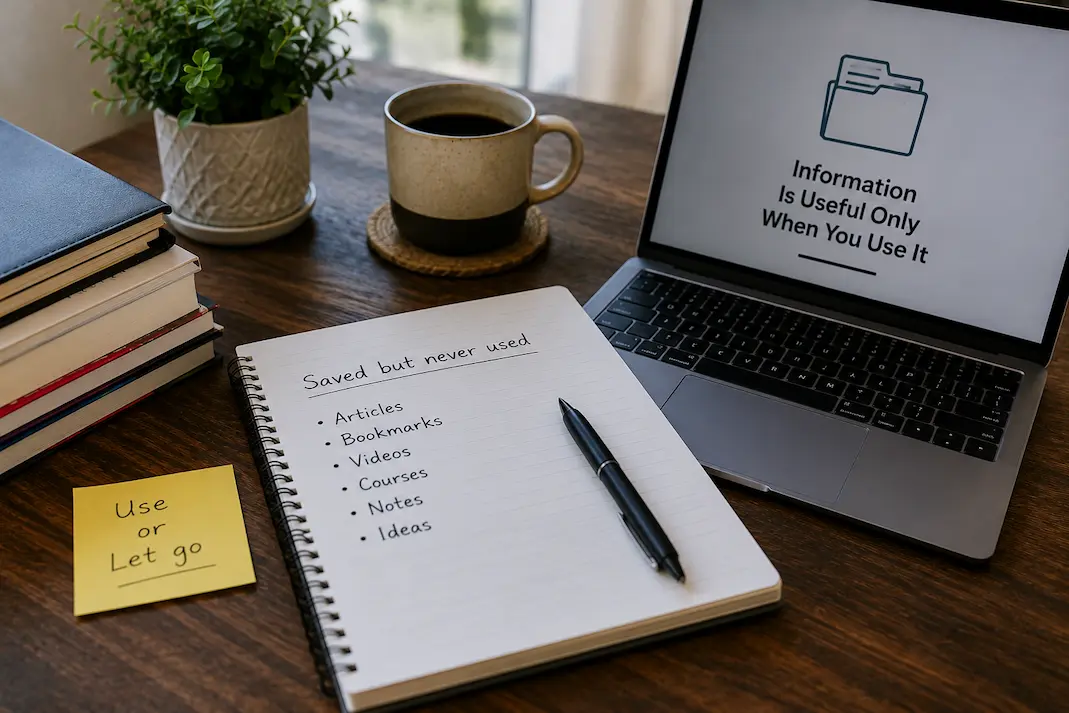
One of the easiest online habits is saving information. You come across something interesting—an article, a manual, a research report, a video, a screenshot, or an idea. Saving it takes just a second; a bookmark, a note, a screenshot, or a quick message to yourself is all it takes. This decision seems harmless because digital storage space appears limitless. The problem arises later, when these small decisions eventually result in hundreds or thousands of saved items that you rarely look at again. By then, much of that information might still be useful, but only a small fraction of it will actually be usable. You have saved the information, but you haven’t necessarily ensured that you will actually get any value out of it.
I have noticed a significant difference between saving information and understanding its meaning. When I save an article simply because it “might be useful,” I am essentially deferring the real decision to an unknown future. Sometimes this is perfectly understandable. At other times, it is simply a way to avoid thinking—a way to keep from asking myself whether the information is truly worth my attention. Research into personal information management points to similar conclusions: saving information is only part of the puzzle; retrieving and reusing that information later are two different things. A collection of saved information is only useful if it can be retrieved, understood, and put to use when needed.
Saving Information Feels like Making Progress
Saving important information provides a certain psychological satisfaction, because the act of saving itself immediately alleviates the fear of losing that information. You see a brilliant explanation and think, “I’ll take another look at that later.” You save a manual because you might need it again someday. You take screenshots because this information might come in handy someday. At the very least, you reduce that uncertainty for the moment. You don’t need to remember the source of the information; your device remembers it for you. However, this convenience also deprives you of the opportunity to assess whether the information is worth learning, remembering, or using.
That is why people easily confuse saving with learning, often without realizing it. Careful reading requires concentration. Learning usually involves some form of processing or application. Saving information requires little effort. Consequently, it is possible to build up a vast repository of information without actually acquiring much additional expertise. A folder full of important material does not guarantee that the material has actually been understood; it merely proves that the items have been stored. Research into personal information management has repeatedly examined the gap between retrieving, storing, and subsequently searching for information. This distinction is crucial, as a massive archive can create the illusion of thorough preparation.
The Real Challenge Lies in Retrieving Information
Nowadays, digital storage is rarely a limiting factor. The real challenge is finding the right information at the right time. Imagine you saved twenty articles on a specific topic six months ago. You know that one of those articles contains the explanation you need, but you cannot remember which one. You open the folder and see that the twenty titles bear little relation to one another. Now you face a new task: searching through your collection. If these materials lack meaningful tags or context, you will likely lose the time you saved earlier during the subsequent search.
Therefore, the true value of personal information management lies not in creating the largest possible archive, but in creating one that remains easily readable. Researchers point out that the key lies in how discovered information is stored, since the value of stored content depends partly on the ability to retrieve and identify it later. An article simply labeled ‘important’ offers little help to your future self. In contrast, an article saved as ‘A comparison of two spaced learning methods; useful for learning projects’ will pique your interest and prompt you to open it. In the latter case, you gain context, and the value of that context can far exceed the value of the stored item itself.
Not Everything You Save Has The Same Purpose
One reason collections become messy is that completely different kinds of information mix together. A recipe you plan to use this weekend is not the same as a research paper you might reference next year. A temporary instruction is not the same as an important document. An interesting idea is not the same as a resource you will definitely need. Yet many digital tools place all of these things into one general category: saved.
Thinking about the purpose of an item makes the decision much easier. Ask what role the information is supposed to play later.
| Information Type | Reason To Keep It | Better Way To Handle It |
|---|---|---|
| Immediate reference | You need it for a current task | Use it rather than postponing it |
| Future reference | You may need it again | Add a useful note or label |
| Learning material | You want to understand it | Study and apply the important parts |
| Permanent record | You need to retain it | Store it deliberately |
| Interesting idea | You simply enjoyed it | Save selectively rather than automatically |
The useful question is therefore not simply, “Could this be useful?” Almost anything could be useful under some imaginary future circumstance. The better question is, “What is this for?” If you cannot answer that, the item may not deserve a permanent place in your collection.
The “Read Later” Trap
“Read later” sounds like a plan, but often it is only a postponement. Later has no natural limit. It can mean tonight, next weekend, next month, or some future period when you supposedly have unlimited free time. Meanwhile, more information keeps arriving. New articles become more interesting, current work becomes more urgent, and old saved material gradually loses its place in your attention.
This creates a strange kind of unfinished business. The saved item is no longer urgent enough to read, but deleting it can feel wasteful because you once considered it valuable. So it stays. Then another item arrives. Then another. Eventually, the collection becomes a record of everything you once thought you might care about rather than a useful collection of things you actually expect to use.
That does not mean read-later tools are bad. They are useful when they contain a manageable number of things that you genuinely intend to revisit. The problem is using them as a substitute for deciding what deserves attention.
Save The Context, Not Just The Link
A bare link often makes sense when you first save it because the reason is fresh in your mind. Six months later, the same link may be almost meaningless. You may not remember what you wanted from it, which section mattered, or whether you intended to read the entire thing. Research into keeping found information has emphasized the importance of context and reminders in later retrieval.
The solution does not require elaborate note-taking. One sentence can be enough. Instead of saving:
Article about memory
you might save:
Useful explanation of retrieval practice; check the section comparing recall and recognition.
Instead of keeping a screenshot with no description, add a short note about what you wanted to remember. The purpose is to leave a clue for your future self. Your future self knows that the information was saved, but may not remember why it mattered.
When A Large Collection Starts Working Against You
A growing collection can create a false sense of security. You may think that having more information available means you are better prepared. But more information also means more decisions about what to trust, what to ignore, and what to retrieve. Research into personal information management has found that people can experience difficulty finding and reusing information as collections grow and become older.
This is particularly noticeable with digital notes and bookmarks because there is almost no physical cost to accumulation. A drawer eventually becomes full, but a browser can hold years of bookmarks without giving you an obvious signal that something is wrong. The limitation appears later in your attention. You cannot realistically revisit everything. You cannot remember why everything was saved. You cannot evaluate everything as carefully as you might like. A smaller collection that you understand can therefore be more useful than a huge collection that you rarely enter.
When Saving Starts Looking Like Digital Hoarding
There is a difference between having many digital files and patterns researchers describe as digital hoarding. Digital hoarding can involve excessive accumulation, difficulty deleting, strong attachment to digital items, and problems managing or retrieving what has been stored. Research has linked stronger digital-hoarding tendencies with difficulties locating information and distress associated with losing saved material.
That does not mean a crowded downloads folder or a large bookmark list is automatically a psychological problem. The term should not be used casually as a diagnosis. There is, however, an ordinary version of the same underlying behavior that many people recognize: “I should keep this just in case.” When that thought becomes the default response to almost everything, accumulation can continue without a corresponding increase in usefulness. The practical solution is not to panic and delete everything. It is to become more deliberate about why information is being kept.
A Better Question Than “Might I Need This?”
The question “Might I need this someday?” is almost impossible to answer negatively. There is always some hypothetical situation in which information could become useful. A better decision process considers probability, replacement difficulty, and context. How likely are you to need it? How difficult would it be to find something similar again? Will you remember what made it useful? Does the information contain something genuinely difficult to reproduce?
That leads to a much simpler approach:
- Use it now when it solves a current problem.
- Save it with context when there is a realistic future use.
- Capture the important part when the whole source is unnecessary.
- Let it go when it is interesting but easily replaceable.
The purpose is not to become extremely strict about saving. Curiosity is a legitimate reason to keep something occasionally. The purpose is to stop every interesting discovery from automatically becoming a permanent responsibility.
Saving Is Not The Same As Learning
This becomes particularly important with educational information. A person can save dozens of excellent articles about writing, programming, history, psychology, or study methods and still understand very little about the subject. The saved material represents potential access, not knowledge that can necessarily be recalled or applied. Learning generally requires more than possession. It requires attention, understanding, retrieval, practice, or some other form of active engagement.
This is why an archive can sometimes become a substitute for study. You save a tutorial instead of practicing. You save a research paper instead of reading the relevant section. You bookmark a course instead of starting it. The collection grows while the actual skill does not. A useful rule is to ask whether the saved resource has a realistic relationship with something you will do. If it does not, keeping it may simply be delaying a decision.
A Practical Cleanup Without Starting From Zero
You do not need to delete your entire saved collection and rebuild it from scratch. A better approach is to start with the material you interact with most. Look through your bookmarks, saved posts, screenshots, or notes and identify items you still clearly understand. Keep the ones with a realistic purpose and add context where necessary. For old items, ask whether the information is still relevant, whether the source still works, and whether finding an alternative would actually be difficult.
You can also use a simple four-part cleanup:
| Keep | Rewrite | Use | Remove |
|---|---|---|---|
| Important future reference | Add missing context | Relevant right now | Easily replaceable material |
The goal is not an empty archive. The goal is confidence. When you open your saved information, you should have a reasonable idea of why those items are there. If the collection becomes easier to understand after a cleanup, you have improved its usefulness even if you still have hundreds of saved resources.
Build A Collection Your Future Self Can Actually Use
A good personal information system does not have to be complicated. It may be nothing more than one reliable place for important resources, a few sensible categories, and a habit of adding a short note when the reason for saving something is not obvious. The important part is consistency. If information is scattered across five applications, several browser folders, screenshots, emails, and random documents, the collection becomes difficult to trust. You may know that something exists somewhere, but that is not the same as being able to retrieve it efficiently.
The best system is usually the one you will continue using without thinking about it. You do not need a complex productivity framework to manage information well. You need a clear enough structure that your future self can answer three questions quickly: What is this? Why did I keep it? Where should I look when I need it? If those answers are easy to find, your collection is doing its job.
Conclusion
Digital storage eliminates most of the physical costs of storing information, but it does not eliminate the costs of subsequently discovering, understanding, and using that information. This is why repositories keep growing, even as their value diminishes. Each saved item may seem insignificant on its own, but after hundreds of subtle decisions, they eventually form a massive repository that needs to be processed. The real goal is not to reduce what you save, but to reduce what you possess. The key is ensuring that the information you save is important enough for you to recognize its value when you revisit it later.
Some information is worth saving. Some information is worth using right away. Some information can be summarized in a brief note. Some information is irrelevant and can be allowed to slip away. Once you make this distinction, saving becomes a deliberate process rather than an instinctive reaction. Your library doesn’t need to contain everything you’ve ever found interesting; it should contain things your future self is likely to understand, locate, and actually use.
Frequently Asked Questions
Is saving information a bad habit?
No. Saving information is certainly useful if you have a legitimate reason to need it in the future. The problem lies in saving things indiscriminately—storing almost anything that interests you without considering the purpose, the context, or how easily it can be retrieved later. Saved content should contribute to your work, studies, or hobbies, rather than becoming a dumping ground for everything you come across. It’s not about how much you save, but whether you can find and use what you’ve stored.
Should I delete data I have never used?
Not necessarily. Some things are worth keeping even if you haven’t used them—such as important documents, unique references, or irreplaceable material. However, if you haven’t looked at something for years, can’t remember why you saved it, and could easily find it again, deleting it probably won’t be a great loss. It is about making a conscious choice regarding what to keep, rather than automatically saving everything.
Does saving articles help with learning?
Saving can aid learning, but simply saving something is not the same as learning. The crucial phase begins after the content has been saved. The value of information lies in reading it carefully, paraphrasing it in your own words, practicing, or applying it in practice. However, constantly adding new learning resources without first organizing existing content can easily distract you.
How do you avoid losing control over saved content?
Decide whether you want to modify the content before saving it. Instead of asking yourself if something might be useful in the future, ask what you intend to use it for and whether it would be difficult to retrieve later. When saving valuable content, add a brief note explaining why. This makes your collection more selective without requiring you to stop saving things altogether. It is also useful to review old materials from time to time so that fleeting information doesn’t turn into permanent data.
What is the most useful information to include when saving links?
Provide background information. A brief explanation of why you find something useful is often more valuable than a detailed organizational scheme. Your future self might remember the webpage but not why it was important. Notes like “a practical explanation of the differences between two learning methods” give the saved information immediate utility. Recent research into personal information management highlights the importance of contextual information, making it easier to retrieve saved resources later.

Abdur Rahman is a writer and digital learning enthusiast focused on critical thinking, self-improvement, productivity, and practical online learning strategies. He shares experience-based articles that help readers build useful habits, improve digital skills, evaluate information more effectively, and develop smarter learning systems for everyday life. Through Knowledge Source Hub, his goal is to make learning simpler, more practical, and accessible for everyone.