
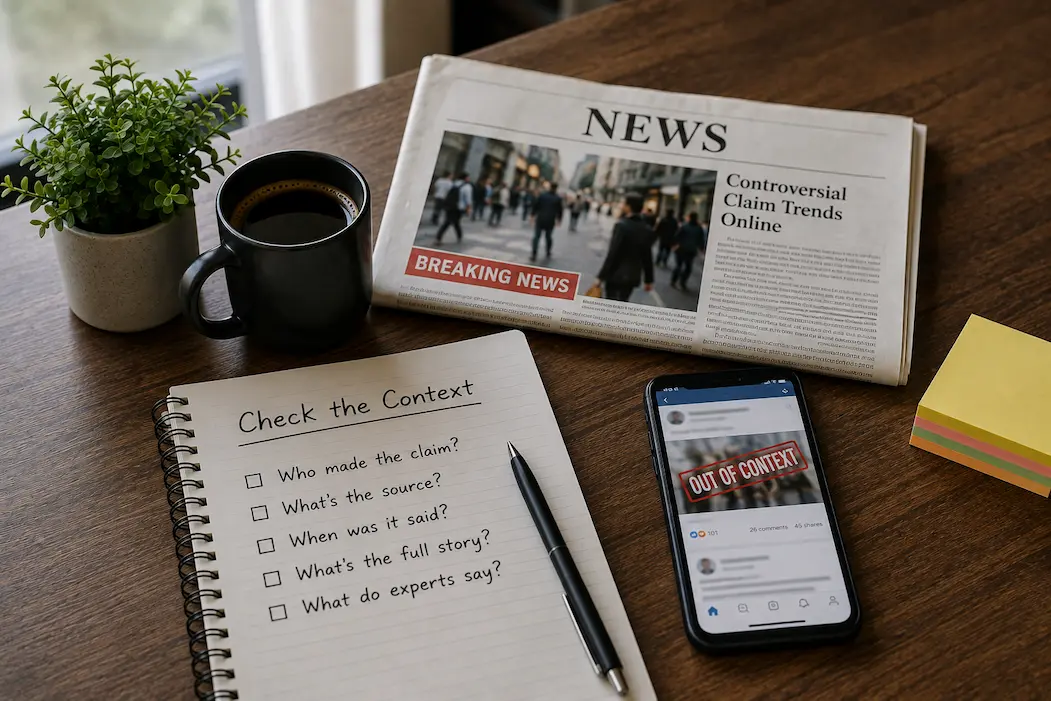
An online claim can be completely true and still give a misleading impression. A statistic can come from a legitimate report, a quotation can be genuine, and a photograph can be authentic, yet the information surrounding them may have disappeared. A number without its timeframe can sound more dramatic than it really is. A quotation without the surrounding conversation can appear to mean something different. An old photograph can be presented as though it shows a recent event. This is why checking whether something is simply “true” is sometimes insufficient. You also need to understand what was left out, because context often determines what a piece of information actually means.
The issue is becoming more important because online information is constantly being shortened and repackaged. An article becomes a headline, the headline becomes a social post, the post becomes a screenshot, and the screenshot gets shared again without the source. Every step can remove details while leaving the central statement intact. UNESCO’s media and information literacy guidance emphasizes examining factors such as source, authorship, date, relevance, and context when evaluating information. The goal is not to become suspicious of everything you see online. The goal is to recognize when you cannot fairly understand a claim from the isolated sentence, number, image, or headline presented to you.
A True Statement Can Still Mislead
People often imagine misinformation as something completely fabricated, but misleading information does not always work that way. Occasionally the individual statement is accurate while the presentation creates a false impression. A company may really have increased sales by 50%, for example, but that figure means something very different if sales went from two units to three. A study may really have found a relationship between two things without proving that one caused the other. A person may genuinely have said a particular sentence while the rest of the conversation made clear that they were discussing a hypothetical situation. The problem is not necessarily the fact itself. The problem is the missing information around it.
That distinction is useful because it prevents critical thinking from becoming a simple hunt for falsehoods. You are not always trying to prove that a claim is wrong. Sometimes you are trying to find out how far the evidence actually allows the claim to go. Does the number apply to everyone or to a particular group? Does the research describe a possibility or establish a conclusion? Does the photograph belong to the event being discussed? Does the statement refer to something happening now or to something that happened years ago? These questions turn a quick reaction into a more careful reading of the evidence.
Context Usually Lives Nearby
The first place to look for missing context is often the original material itself. Read the paragraph before the quoted sentence and the one after it. Check the full headline and article rather than relying on a screenshot. Look at the caption below an image. If an article mentions a study, follow the reference and see what the study actually examined. These steps are basic, but online platforms reward speed, and people often encounter information in a form designed to be consumed in seconds rather than examined carefully.
There is another useful habit: do not assume that the page containing the claim is the only place where the necessary information exists. Research into professional fact-checkers found that they frequently used lateral reading, meaning they moved away from the original page and checked other sources rather than accepting the page’s own description at face value. This is particularly useful when a website is making a surprising claim about research, statistics, organizations, or public events. The original source tells you what is being presented. Independent material can help you understand whether that presentation leaves anything important out.
The Missing Detail Is Often One Of These
Context can mean many things, but most problems tend to involve a few recurring categories. A claim may look very different when you discover when it was produced, who it applies to, how the measurement was made, or what the source itself says about its limitations.
| Missing Context | Why It Matters |
|---|---|
| Date | Information may have changed since it was published |
| Population | A finding about one group may not apply to everyone |
| Comparison | A percentage or increase needs a baseline |
| Source | A secondary summary may simplify the original evidence |
| Definition | Important terms may mean something more specific than they appear |
| Limitation | Evidence may support a narrower conclusion than the headline suggests |
These details are easy to overlook because they are usually less interesting than the claim itself. Yet they can entirely change the interpretation. “Users increased by 80%” sounds dramatic until you know the starting number. “A study found that X causes Y” sounds decisive until you discover that the study only measured an association. “This happened recently” loses meaning when the photograph was taken several years ago. Context is often part of the claim itself. This information is necessary for correctly interpreting the claim.
Numbers Need More Than Precision
Statistics create a particular problem because precise numbers look authoritative. A figure such as 73%, 300%, or 1.2 million seems more trustworthy than a vague statement, but precision does not guarantee meaning. You still need to know what was counted, how it was measured, who was included, and what comparison produced the number. UNESCO’s information-literacy guidance similarly recommends examining source details, dates, relevance, reliability, and context rather than treating numerical precision as proof of credibility.
Consider the difference between saying that a rate increased by 20% and saying that it increased by 20 percentage points. Those statements can describe very different changes. The same problem appears when an article reports an average without explaining the distribution, or when a survey result is presented without identifying the sample. A careful reader does not have to become a statistician to notice these issues. The important habit is simply to ask, “Compared with what, measured how, and among whom?” Those three questions often reveal the missing context immediately.
Headlines And Quotes Are Especially Vulnerable
A headline has to compress a complicated story into very few words. That can make it useful, but it can also make it misleading if readers never open the full article. A cautious research finding can become a strong-sounding discovery. A statement about a specific group can sound universal. A possible explanation can appear to be a fact. Once the headline is copied into another post, the qualifications contained in the original article may disappear completely.
Quotes face a similar problem. A sentence can be reproduced word for word and still create a misleading impression when separated from the question, answer, or explanation surrounding it. When a quotation seems unusually extreme or surprisingly definitive, finding the complete interview, speech, report, or transcript is worthwhile. The goal is not to assume that longer versions are always more truthful. It is to see whether the shortened version preserves the original meaning. A few words before or after a quotation can sometimes change its interpretation substantially.
Images And Screenshots Have Context Too
Images are often treated as self-explanatory, but they are not. A genuine photograph can be attached to the wrong event. A real video can be described as though it was recorded somewhere else. A screenshot can remove the part of a conversation that explains what the visible sentence actually means. In these situations, the visual material itself may be authentic while the claim attached to it is false or misleading.
One useful technique is to investigate where an image first appeared and compare the earliest available description with the one currently circulating. Stanford’s digital-literacy resources recommend reverse image searching as one method for checking whether images have been reused, altered, or presented out of context. This creates an important distinction: “Is this image real?” is not the same question as “Does this image show what this post says it shows?” The second question is about context, and it can be just as important as authenticity.
Missing Context Does Not Automatically Mean Deception
It is also worth avoiding the opposite mistake. Not every claim missing context was deliberately designed to mislead. A person may shorten a statement because of a character limit. A journalist may summarize a complicated study for a general audience. Someone sharing a photograph may simply have received incomplete information about where it came from. Intent can be difficult to establish, and determining whether something was deliberately misleading is often less useful than examining whether the information itself supports the conclusion being presented.
The APA has noted that misleading content can involve missing context, manipulated information, and opinions presented as facts, and it also recognizes that motives can be difficult to establish. This is an important distinction because it keeps information evaluation focused on evidence rather than speculation about the person who posted it. You do not need to decide whether someone was dishonest before deciding that a claim needs more verification.
A Practical Context Check
When a claim matters enough to influence a decision, be shared publicly, or become part of your own work, give it a slightly slower reading. Start with the exact statement being made, then locate the source if possible. Check the date and the population or situation involved. Seek the evidence supporting the conclusion and any limitations mentioned by the source. If a number is central to the argument, find out what it is being compared with. When an image or quote is involved, look for the original version instead of relying on the edited one.
You do not need to perform a full investigation every time you encounter something online. The amount of checking should depend on the importance of the claim. A strange fact in a casual conversation may not deserve much attention. A statistic being used in an article, a claim included in a presentation, or information that could affect an important decision deserves considerably more scrutiny. Good information habits are not about checking everything equally. They are about recognizing when missing context could change the conclusion.
Conclusion
The internet makes knowledge fast, easy, and portable to share, but these very qualities often cause us to lose context. A line of text can be lifted from a paragraph, a statistic stripped of its technical perspective, a photo detached from its date, and a quote removed from the context that gives it meaning. The remaining fragment may seem plausible because the text or images themselves are authentic. However, the information that tells you how to interpret those words or images is gone.
That is why it is wise to pause and reflect when you hear a claim that sounds particularly sensational, certain, or deceptively simple. Check the source, the date, the scope, the comparisons, the evidence, and the limitations. How would knowing this information affect your interpretation? Sometimes the original claim is well-founded. Sometimes it is overly convoluted. Occasionally the most accurate conclusion is far more complex than what you initially see in the stream of information. And a reliable understanding often begins with piecing together this additional context.

Abdur Rahman is a writer and digital learning enthusiast focused on critical thinking, self-improvement, productivity, and practical online learning strategies. He shares experience-based articles that help readers build useful habits, improve digital skills, evaluate information more effectively, and develop smarter learning systems for everyday life. Through Knowledge Source Hub, his goal is to make learning simpler, more practical, and accessible for everyone.