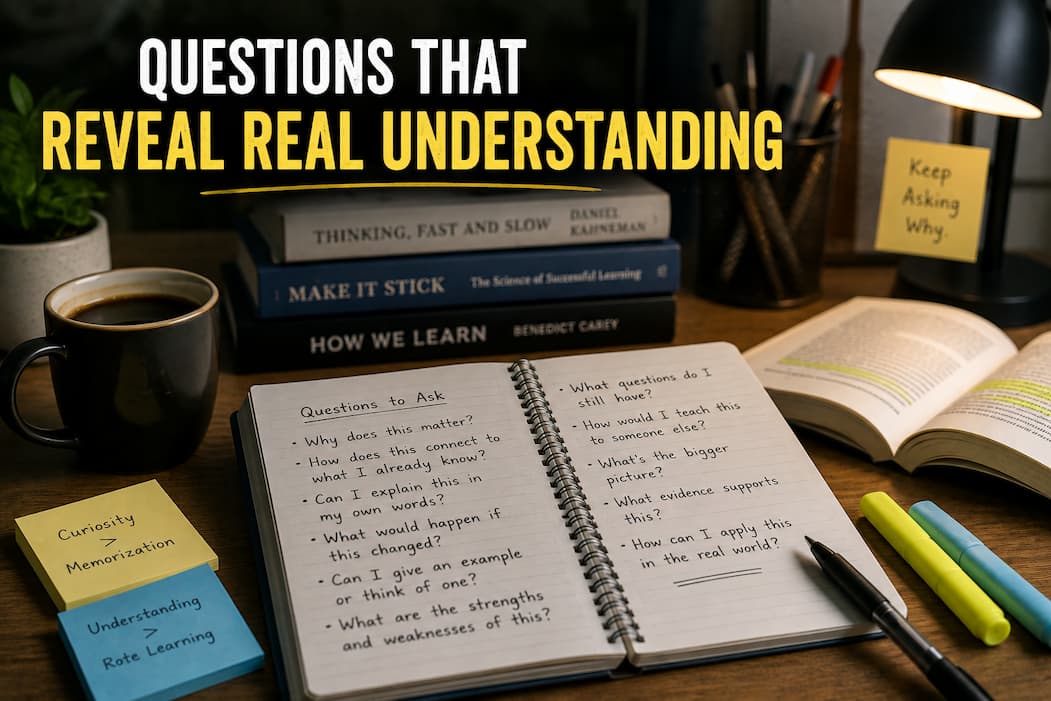
It is surprisingly easy to mistake familiarity for understanding. After reading the same explanation several times, the words begin to look comfortable. You recognize the terminology, remember roughly where the important part appeared, and may even feel that you could explain it if someone asked. Then the notes disappear, and the explanation suddenly becomes much harder to reconstruct. This happens because recognizing information is easier than producing it independently. Real understanding becomes clearer when you do something with an idea rather than just recognize it on a page.
I have found that questions are one of the simplest ways to expose this difference. A good question forces you to move information around in your mind. Instead of asking whether the material looks familiar, you have to explain it, connect it to something else, apply it, or identify where it stops working. Research on retrieval practice has found that actively retrieving information can improve later retention compared with repeatedly studying the material without retrieval. (pubmed.ncbi.nlm.nih.gov) The important point is not to turn every study session into an examination. It is to use questions that reveal whether the idea has actually become usable knowledge.
Can You Explain It Without The Original Words?
One of the first tests of understanding is simple: close the book, notes, or article and explain the idea in your own words. This sounds easy until you try it with something you have only recently encountered. You may remember several phrases from the original explanation but struggle to connect them into a coherent description. That gap matters because repeating familiar wording can create the feeling of understanding without requiring you to construct the idea yourself. A genuine explanation should survive even when the original sentence structure is gone.
This does not mean you need to explain everything perfectly from memory. The purpose is to discover where your understanding becomes vague. If you can describe the central idea but cannot explain why it works, that is useful information. If you remember the definition but cannot give a simple example, you have found another gap. Instead of immediately rereading the entire chapter, return to the specific part that caused difficulty. The question has done its job: it has shown you where additional learning is needed.
What Problem Does The Idea Actually Solve?
Definitions can be memorized without understanding why a concept exists. Asking what problem an idea solves forces you to connect it to a situation rather than treating it as an isolated piece of information. For example, knowing that a particular study technique involves retrieving information is different from understanding why someone would use it. Knowing that a spreadsheet function performs a calculation is different from knowing when that function is useful. Knowledge becomes more flexible when you understand the problem it was designed to address.
This question is especially useful for subjects filled with terminology. Technical words can make notes look sophisticated while hiding shallow understanding. When you ask what problem a concept solves, you have to move beyond vocabulary and think about purpose. If you cannot identify the problem, the concept may still be something you recognize rather than something you understand. That does not mean the learning session failed. It simply tells you that the next stage should focus on relationships and application rather than collecting more definitions.
Can You Give A New Example?
A strong way to test understanding is to create an example that was not included in the material you studied. This forces you to transfer the idea into a different situation. If you can only repeat the example from the textbook or article, it may be difficult to tell whether you understand the underlying principle or simply remember it. Creating your own case requires you to identify what features actually matter and which details were specific to the original situation.
Suppose you are learning about confirmation bias. Remembering the definition is one level of understanding. Describing an entirely new situation in which someone searches only for information supporting an existing belief demonstrates something more. You have recognized the pattern and transferred it. That kind of transfer is more revealing because real life rarely presents information in the same form as a textbook example. If the idea can survive a change of context, your understanding is becoming more flexible.
What Would Be A Counterexample?
A counterexample can reveal weak understanding very quickly. Ask yourself whether you can think of a situation in which the rule, explanation, or expectation does not apply. This is particularly useful when learning general principles because beginners often turn useful rules into absolute ones. A concept may work under certain conditions but fail when those conditions change. Finding the boundary helps you understand the concept more precisely.
For instance, suppose you learn that reducing distractions can improve concentration. A weak interpretation might be “fewer distractions always produce better work.” A stronger understanding recognizes that other factors can matter too, and that removing every possible interruption is not always practical or even desirable. Looking for exceptions forces you to identify the limits of the idea. That makes your knowledge less fragile because you are no longer treating a useful principle as a universal law.
How Is This Connected To Something You Already Know?
Understanding rarely develops in isolation. New information becomes easier to use when you can connect it with concepts already stored in memory. Asking “What does this remind me of?” or “What is this similar to?” can reveal those connections. Occasionally the comparison will expose an important difference as well. Both processes are useful because they prevent new information from remaining a disconnected fact.
For example, learning about correlation can be connected to the earlier idea that two events appearing together does not automatically establish causation. Learning a new note-taking method can be compared with a method you already use. Learning a computer shortcut can be connected to the larger workflow it improves. The point is to avoid forcing a connection where none exists. It is to look for relationships that make the information easier to retrieve and apply later.
Can You Use It Without Looking It Up?
A concept may feel familiar while remaining difficult to use independently. This is why an application question is often more revealing than another definition question. Instead of asking “What is this?”, ask “Where would I use this?” or “What would I do differently because I know it?” The answer forces you to turn knowledge into a decision or action.
This is especially important for practical subjects. Knowing the features of a spreadsheet function does not prove that you can choose the right function for a real problem. Knowing the principles of good research does not prove that you can evaluate an unfamiliar source. Knowing a learning technique does not prove that you can use it effectively when studying a difficult chapter. Application reveals whether the knowledge is operational rather than merely descriptive.
Could You Teach It To Someone Who Knows Nothing About It?
Pretending to teach a concept is another useful test because teaching requires organization. You have to decide what matters first, what needs an example, which terms need explanation, and which details can wait. If you understand only the original wording, the explanation often collapses as soon as you try to make it simpler. If you understand the structure of the idea, you can usually explain it in several different ways.
The explanation does not need to become a formal lecture. Try speaking aloud for two minutes as though someone asked you about the subject. Notice where you hesitate or start repeating words from the original source. Those moments are clues. They show where your mental model is incomplete. You can then return to the material with a much more specific question instead of rereading everything and hoping familiarity will eventually turn into understanding.
Questions That Expose Different Kinds Of Gaps
Every learning problem is different, which is why one question cannot test everything. A person may know the definition but not the purpose. They may understand the principle but not know how to apply it. They may apply it correctly in familiar examples but fail when the situation changes. Using a small variety of questions gives you a more realistic picture of what you actually know.
| Question | What It Tests |
|---|---|
| Can I explain it simply? | Basic understanding |
| Why does it work? | Mechanism or reasoning |
| Can I give a new example? | Transfer |
| When would it fail? | Boundaries and exceptions |
| What is it connected to? | Relationships |
| Can I use it? | Application |
| Could I teach it? | Organized understanding |
The table is not meant to become another rigid study routine. You do not need to answer every question for every topic. Pick the questions that match the kind of knowledge you are trying to develop. A mathematical procedure may need application. A historical concept may need explanation and connection. A scientific claim may need boundaries and evidence. The purpose is to ask a question that requires you to do more than recognize the material.
Understanding Becomes Clearer When The Notes Disappear
Digital notes are useful, but they can also make weak understanding harder to notice because the answer is always nearby. If you immediately look at the explanation whenever something feels difficult, you may miss the chance to see if you could reconstruct it independently. Retrieval practice research provides strong evidence that actively recalling information can strengthen later access to it. (pubmed.ncbi.nlm.nih.gov)
That does not mean studying without notes all the time. A better approach is to alternate between recall and checking. Close the material, answer a question, and then compare your answer with the source. The purpose of checking is not to prove that your memory is perfect. It is to identify gaps. In that sense, your notes become a reference against which you can test your understanding instead of becoming something you continuously reread.
Conclusion
Real understanding is difficult to measure by appearance. Full notes, familiar terminology, and repeated reading can make a subject feel comfortable without making it usable. Better questions expose what happens when the support is removed. Can you explain the idea without copying the source? Can you create a new example? Can you find an exception? Can you connect it to something you already know? Can you use it when the situation changes? Those questions reveal much more than another quick rereading session.
The useful part is not getting every answer right on the first attempt. A question that exposes a gap has already done something valuable because it tells you where to focus next. Instead of studying everything again, you can investigate the specific weakness, try another explanation, and test yourself once more. Learning becomes less about collecting pages of information and more about building knowledge that remains available when the original page is no longer in front of you.
Frequently Asked Questions
Is Remembering The Definition Enough To Show Understanding?
Usually not by itself. Remembering a definition is useful, but understanding becomes clearer when you can explain the concept in your own words, connect it to another idea, recognize an example, or apply it in a new situation. A person can memorize a definition without understanding what the concept looks like outside the original lesson.
What Is The Best Question For Testing Understanding?
There is no single best question for every subject, but “Can I explain this in my own words and use it in a new example?” is a strong starting point. It tests whether you can reconstruct the idea and transfer it beyond the original explanation. For more advanced understanding, asking where the idea does not apply can reveal another layer of knowledge.
Why Do I Feel Like I Understand Something Until I Close My Notes?
Recognition can feel easier than recall. When the material is visible, familiar words and structures provide cues that make the information seem obvious. Once those cues disappear, you may discover that you cannot reconstruct the idea independently. This is one reason retrieval practice is useful during learning rather than relying entirely on rereading. (pubmed.ncbi.nlm.nih.gov)
Should I Ask Myself Questions While Studying?
Yes, but they do not need to interrupt every few sentences. After a meaningful section, pause and ask a question that requires you to explain, apply, compare, or recall the material. The goal is to create moments where you have to produce the knowledge rather than continually recognize it on the page.

Abdur Rahman is a writer and digital learning enthusiast focused on critical thinking, self-improvement, productivity, and practical online learning strategies. He shares experience-based articles that help readers build useful habits, improve digital skills, evaluate information more effectively, and develop smarter learning systems for everyday life. Through Knowledge Source Hub, his goal is to make learning simpler, more practical, and accessible for everyone.