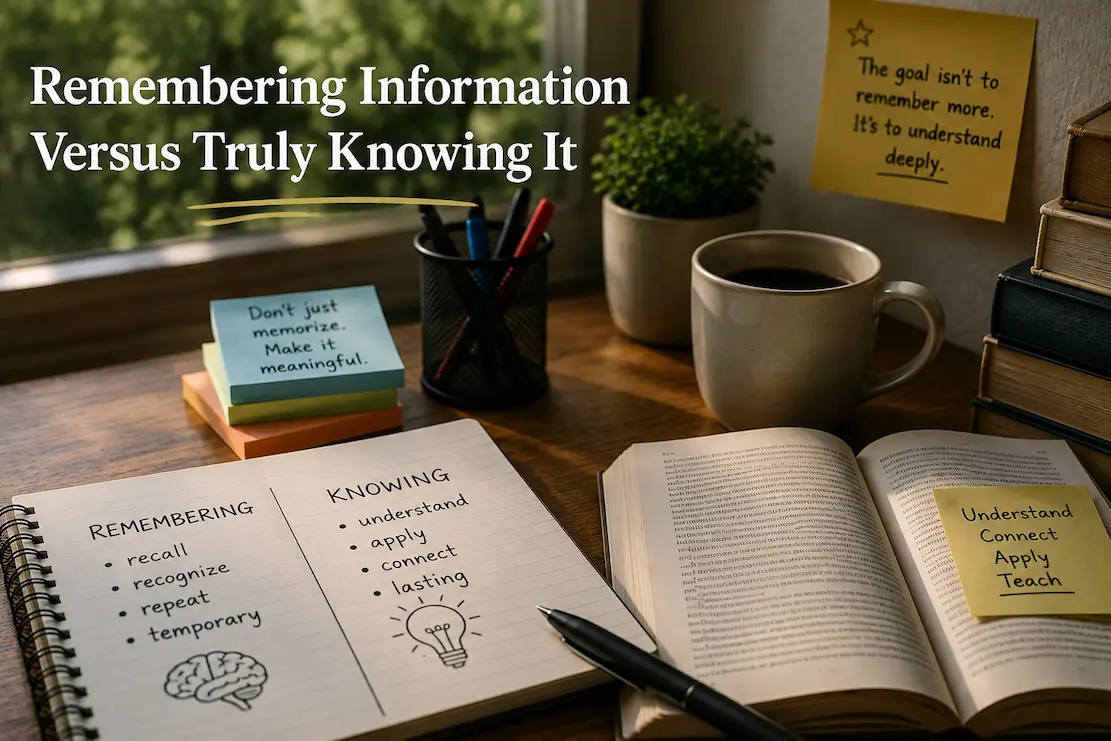
There is a difference between recognizing information and actually knowing it, and that difference becomes obvious when the page in front of you disappears. You can read a definition several times and feel comfortable with it, yet struggle when someone asks you to explain it without looking. You can recognize the correct answer in a multiple-choice question but have difficulty producing it yourself. You can even remember a sentence almost word for word without being able to use the underlying idea in a different situation. These experiences are not unusual. They show that familiarity with information and usable knowledge are related, but they are not the same thing.
I have found this distinction particularly useful when studying because it changes what I consider evidence of learning. A full set of notes can show that I spent time with a subject, but it does not necessarily show that I can work with the subject independently. Research on learning has consistently found benefits from retrieval practice, where learners actively recall information rather than simply studying it again. The real test, then, is not whether information looks familiar when you see it. It is whether you can still retrieve, explain, connect, and use it when the original material is no longer doing the work for you.
Familiarity Can Create A False Sense Of Knowing
One reason this distinction is easy to miss is that familiarity feels convincing. When you read the same explanation several times, the words become easier to recognize and the material starts to feel comfortable. That comfort can be interpreted as learning, even though you may not be able to reproduce the idea independently. Research on self-regulated learning has found that people can misjudge their own learning partly because the subjective feeling of fluency does not always correspond to how well information can later be retrieved. In other words, something can feel easy to recognize without being easy to remember when you actually need it.
A simple experiment exposes this quickly. Read a short explanation, close it, and try to explain the main idea aloud without looking back. The experience is often different from what you expected. You may remember the general subject but lose the important relationship between the parts. You may remember an example but forget why it worked. That gap is useful information rather than evidence that studying failed. It tells you that recognition was stronger than recall and gives you a clearer idea of what needs more work.
Remembering A Fact Is Only One Part Of Knowing It
Memory is still important. If you cannot remember a basic fact or concept, it is difficult to use it later. But knowing something usually involves more than being able to repeat a definition. You should ideally be able to explain what it means, recognize when it applies, connect it to related ideas, and use it in an appropriate situation. Research on retrieval practice suggests that testing can improve not only later recall but, under some conditions, transfer to new questions and applications. A large meta-analysis covering more than a hundred experiments found evidence that test-enhanced learning can transfer to different contexts, although the size of that benefit depends on how the learning and later test are structured.
This is why I prefer to ask more demanding questions after learning something important. Instead of stopping at “Can I remember the definition?”, I ask, “Could I explain this to someone unfamiliar with it?” Then I might ask, “Could I give an example that wasn’t in the lesson?” or “What would change if one of the conditions were different?” Each question requires a different kind of mental work. Together, they reveal whether the information has become flexible knowledge rather than a sentence that can be repeated under familiar conditions.
The Real Test Is What You Can Do With It
Application is where the difference between remembering and knowing becomes especially clear. Suppose you have learned the definition of confirmation bias. You may remember the terminology perfectly, but that does not necessarily mean you can recognize the pattern when it appears in an unfamiliar situation. To know the concept more deeply, you should be able to identify an example, explain why it fits, and distinguish it from a similar but different reasoning error.
The same principle applies to practical skills. Knowing the steps of a spreadsheet function is different from recognizing when that function is the appropriate solution. Knowing the rules of a language is different from producing a sentence naturally. Knowing a learning technique is different from deciding when it is useful. Research on retrieval and transfer shows that applying knowledge across different examples can improve its ability to transfer to new situations. This is one reason varied practice can be more revealing than repeatedly answering the same familiar question.
Explanation Exposes Weak Spots
One of the most useful tests is also one of the simplest: explain the idea in your own words. Avoid looking at the original definition and try to describe what the concept means, why it matters, and perhaps give a basic example. If you find yourself copying the original wording mentally, that is a useful warning sign. You may know the language surrounding the idea without having built a clear explanation of your own.
Self-explanation has been studied as a learning technique, with research suggesting that generating explanations can support learning, although its effects depend on what is being explained and how the activity is used. This is important because explaining is not a magic technique that automatically proves mastery. Its value comes from the mental effort involved. When you try to explain an idea without relying on the original source, you discover where your understanding is coherent and where it becomes vague.
A Useful Knowledge Check
A practical check does not need to become another complicated study system. After learning something, close your notes and work through a few questions that match the subject.
| Question | What It Reveals |
|---|---|
| Can I explain it simply? | Basic understanding |
| Can I recall the main idea without notes? | Retrieval |
| Can I create a new example? | Transfer |
| Can I explain why it works? | Deeper understanding |
| Can I identify a limitation or exception? | Boundaries |
| Can I use it in a new situation? | Practical knowledge |
You do not have to answer every question every time. A history topic may benefit from explanation and connections, while a practical skill may need more application. The point is to move beyond recognition. If you can only answer when the original wording or example is visible, you probably need more retrieval or practice. If you can explain the idea but cannot apply it, the missing piece may be transfer rather than memory.
Retrieval Is More Revealing Than Rereading
Rereading is comfortable because the information is immediately available. Retrieval is harder because the information has to come from you. That difficulty can make retrieval feel less efficient, but research has repeatedly found that practicing retrieval can strengthen later retention. A major review describes retrieval practice as a robust learning technique that can slow forgetting across different materials and learner groups. Earlier research also found that retrieval practice can promote longer-term retention and, in some circumstances, more flexible use of knowledge.
A simple way to use this is to delay looking at your notes. Read a section, close the material, and reconstruct the main points. Then reopen the notes and compare your version with the original. The mistakes and omissions are useful because they show what your memory actually retained. You are not trying to prove that you can remember every sentence. You are checking whether the important structure of the idea is available without assistance.
Knowing Also Means Knowing Where You Might Be Wrong
There is another part of genuine knowledge that gets overlooked: recognizing the limits of what you know. Someone who remembers a rule perfectly may still misunderstand when it applies. Someone who can recite a statistic may not know what population it describes. Someone who knows a definition may not recognize an exception. Awareness of uncertainty can therefore be a sign of deeper understanding rather than a weakness.
This is especially important when learning subjects with competing explanations or complex evidence. A person who truly understands an idea should usually be able to say something about where it works, where it does not, and what assumptions it depends on. That does not require knowing every possible exception. It means resisting the temptation to turn a useful principle into an absolute rule. Asking yourself “What would make this explanation fail?” can reveal a level of understanding that simple recall cannot.
The Goal Is Usable Knowledge
The most useful way to think about learning is not as a competition between memory and understanding. Memory supports understanding because you need information available in your mind to work with it. Understanding, in turn, gives remembered information a structure that makes it easier to use. The problem occurs when recognition is mistaken for both. A page of familiar notes can create a strong feeling that you know something, while the real test has not happened yet.
That test is fairly simple: close the material and do something with what you learned. Explain it. Recall it. Give a new example. Compare it with another idea. Find an exception. Apply it to an unfamiliar problem. Research on retrieval practice shows that learning can benefit from this active process, and evidence also suggests that varied retrieval can support transfer to new contexts. You do not need to turn every study session into a formal test. You simply need occasional moments where the information has to work without the page carrying it for you.
Frequently Asked Questions
Is Remembering Something The Same As Knowing It?
Not always. Remembering is an important part of knowledge, but deeper knowing usually involves being able to explain, connect, and apply what you remember. A person may memorize a definition accurately and still struggle to recognize the concept in an unfamiliar example. Testing recall and then applying the idea can provide a better indication of whether the information has become usable knowledge.
Why Does Something Feel Easy After I Read It Several Times?
Repeated exposure can increase familiarity and make information feel fluent. That feeling can be mistaken for strong learning, even when independent recall is weak. Research on self-regulated learning has found that subjective feelings of fluency can contribute to inaccurate judgments about how well material has actually been learned. Closing the material and trying to reproduce the important ideas is a better test.
Is Retrieval Practice Better Than Rereading?
Retrieval practice has strong evidence behind it as a way of supporting later recall, and reviews have found benefits across different types of material. That does not mean rereading has no value. Re-exposure can help you notice information you missed, but actively retrieving the material provides a different kind of learning experience and can reveal whether the information is actually accessible without the source.
Conclusion
Remembering information is the foundation, but it is not the whole structure. You can recognize a definition, remember an example, and still struggle when the material is presented differently. Genuine knowledge becomes more visible when you have to produce something from what you learned without the source thinking for you. That might mean explaining an idea, solving a new problem, comparing two concepts, or recognizing where a rule stops applying.
The most useful test is therefore, “Does this look unfamiliar?” It is, “What can I do with this when the notes are closed?” That question changes learning from collecting information into building something you can actually use. Retrieval practice, explanation, varied examples, and application all provide ways to find out whether the knowledge is available independently. You do not need to remember everything. You need to know enough that the important ideas remain usable when the page, video, or lecture is no longer in front of you.

Abdur Rahman is a writer and digital learning enthusiast focused on critical thinking, self-improvement, productivity, and practical online learning strategies. He shares experience-based articles that help readers build useful habits, improve digital skills, evaluate information more effectively, and develop smarter learning systems for everyday life. Through Knowledge Source Hub, his goal is to make learning simpler, more practical, and accessible for everyone.