
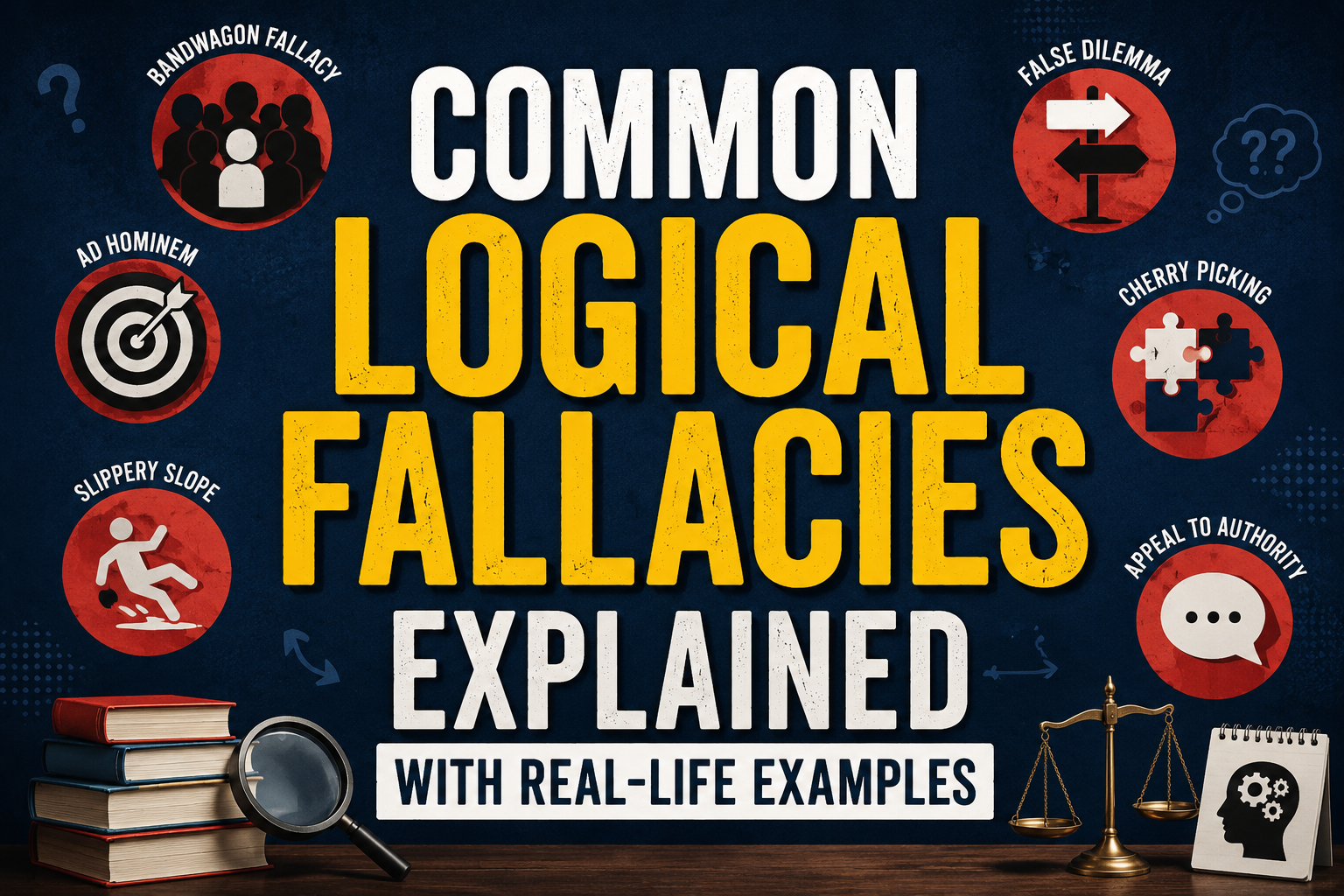
Arguments shape the way we make decisions—at work, in personal life, and online. Yet, many debates or discussions that sound convincing actually rest on shaky reasoning or outright fallacies. Logical fallacies, whether used accidentally or intentionally, weaken arguments and can mislead people. If you want to avoid being swayed by bad logic and want to argue more effectively yourself, you must understand these common errors.
What Are Logical Fallacies and Why Should You Care?
A logical fallacy is an error in reasoning that makes an argument unsound. Fallacies sneak into conversations all the time—sometimes by mistake, sometimes as a tool to persuade without real evidence. They work well because they often tap into emotions or social pressures, making false points appear true.
Spotting these fallacies helps you ignore distractions and focus on substance. When you recognise them, you become better at thinking critically—less likely to be fooled by advertising, political spin, or biased articles. Let’s break down several major logical fallacies, how they appear in real conversation, and what you can do to respond to them.
The Ad Hominem Fallacy: Focusing on the Person, Not the Argument
“Ad hominem” means targeting the person making the argument instead of the argument itself. You’ll see this in political debates and internet comments—one person dismisses another’s valid argument by attacking their character or history rather than addressing their point.
For example, if a local resident proposes a new community park and someone replies, “His opinions mean nothing; he failed at business,” that’s an ad hominem attack. The personal jab has nothing to do with the idea of building a park. Recognise when discussions move off-topic like this, and try to steer the conversation back to actual evidence or reasoning.
[IMAGE: two businessmen sitting across from each other at a conference table looking mildly frustrated during a debate]
The Straw Man Fallacy: Misrepresenting the Other Side
A straw man fallacy happens when someone oversimplifies or exaggerates another’s argument to make it easier to attack. In real life, such an argument might look like a manager suggesting, “Let’s allow remote work two days per week,” and a colleague responding, “If everyone stays home, nothing will get done.” The original suggestion wasn’t for everyone to “stay home all week”; that’s a distortion that’s easier to criticise.
When your viewpoint is misrepresented, calmly restate your actual position and ask others to respond to what you really said.
Bandwagon Appeal: “Everyone Is Doing It”
This fallacy claims something is true or good simply because many people believe or do it. We see it in marketing—“Millions have switched; why not you?”—and in peer pressure scenarios.
Popularity alone is not proof of quality or correctness. For example, just because “everyone” is buying a specific cryptocurrency doesn’t mean it’s a safe investment.
Here’s a table to show the difference between this fallacy and arguments grounded in real evidence:
|
Argument Type |
Key Feature |
Example |
|---|---|---|
|
Bandwagon Fallacy |
Relies on popularity |
“Everyone is investing in it, so it must be good.” |
|
Evidence-Based Claim |
Relies on facts or expert findings |
“Independent audits show this fund returns 5% annually.” |
[IMAGE: a large crowd of people walking together on a busy city street during daytime]
The Slippery Slope: Exaggerating Possible Consequences
Sometimes, people claim that one small step will lead to a chain of extreme events, without evidence for such a progression. For example, “If we let students dye their hair, next they’ll ditch homework, and then our school will collapse academically.” This argument envisions the worst possible outcome, but it lacks a logical connection.
Challenge slippery-slope arguments by asking for actual evidence connecting each step, rather than accepting the chain reaction at face value.
False Dilemma (Black-or-White Thinking): Limiting Choices
When a discussion presents only two options—one good, one terrible—while ignoring reasonable alternatives, it’s called a false dilemma. This tactic is common in heated negotiations and sales pitches:
- “You either buy this warranty now or risk significant repair costs.”
- If you do not support this law, it suggests that you do not care about our schools.
In truth, situations are often shades of grey. When you hear this kind of argument, pause and look for other real options that have been left out.
[IMAGE: a person looking thoughtfully at a whiteboard covered in complex flowcharts and multiple-coloured sticky notes]
Common Logical Fallacies at a Glance
Here’s a bullet-point list summarising the key fallacies discussed so far:
- Ad hominem: Discrediting someone based on personality or history, not their ideas.
- Straw man: Twisting an opponent’s argument into an extreme version, then refuting that.
- Bandwagon: Claiming something is correct because it’s popular.
- Slippery slope: Predicting unreasonable consequences from a small starting point.
- False dilemma: Framing an argument only to consider two choices.
How to Spot Logical Fallacies: A Step-By-Step Guide
Catching logical fallacies gets easier with practice. Use these steps during any debate or discussion:
- Listen carefully and restate the argument to isolate the main claim.
- Seek evidence—does the speaker’s support logically connect to the claim?
- Notice diversion tactics—like personal attacks or exaggerating your position.
- Check for excessive emotion or forced choices that obscure details.
- Ask clarifying questions—such as “What other options exist?” or “How did you get from A to Z?”
Frequently Asked Questions
How are cognitive biases different from logical fallacies?
Cognitive biases are internal habits of thought that sway how people interpret information, while logical fallacies are outward errors in reasoning that show up in arguments and claims.
Can a flawed argument arrive at a correct conclusion?
It’s possible. The reasoning may be faulty, but the final answer may still be correct due to coincidence or other unrelated factors. Sound reasoning improves your odds of being correct.
Why do intelligent people still use fallacies?
Even smart people use fallacies—sometimes to persuade, sometimes by accident. They can be powerful tools when someone can’t provide solid evidence for their point.
How can I point out fallacies without being rude?
Focus on the issues, not the person. Say, “Let’s talk about the facts” or “Can you explain how your evidence leads to your conclusion?”
Is appealing to authority always a fallacy?
Not always. It’s only wrong if the authority cited isn’t an expert on the topic at hand. If a real expert speaks on their speciality, referencing them is valid.
Final Thoughts
Learning about common logical fallacies helps you think more clearly, argue more fairly, and guard against misinformation. From business meetings to family discussions, recognising these patterns lets you ask better questions and make more informed decisions. The next time you find yourself in a debate, remember these fallacies—and use your understanding to keep the conversation honest and productive.

Abdur Rahman is a writer and digital learning enthusiast focused on critical thinking, self-improvement, productivity, and practical online learning strategies. He shares experience-based articles that help readers build useful habits, improve digital skills, evaluate information more effectively, and develop smarter learning systems for everyday life. Through Knowledge Source Hub, his goal is to make learning simpler, more practical, and accessible for everyone.