
Let me ask you something honest: How many times have you woken up on January 1st absolutely certain that this was the year you’d finally get fit, eat healthier, or build a consistent morning routine? You felt that fire in your chest. The motivation was real. And then… by February 15th, you were back to your old patterns, wondering what went wrong.
Here’s the uncomfortable truth that most self-help gurus won’t tell you: Motivation is wildly unreliable. It shows up like a summer thunderstorm — intense, dramatic, and gone before you know it. Research from the University of Scranton suggests that only about 8% of people actually achieve their New Year’s resolutions. The other 92%? They didn’t lack motivation. They lacked the right environment.
Behavioral scientist B.J. Fogg, founder of the Behavior Design Lab at Stanford University, puts it perfectly: “Design beats willpower.” Your environment — the physical spaces you inhabit, the digital spaces you scroll through, and the social circles you move in — quietly dictates your daily choices far more than your best intentions ever will. When your environment is designed to support your goals, good habits become the path of least resistance. When it’s not, even the most motivated person will eventually crumble.
The Science Behind Environment and Behavior
Your brain is essentially a pattern-matching machine that takes cognitive shortcuts to conserve energy. Psychologists call these shortcuts “heuristics,” and they’re the reason why your environment has such outsized influence on your behavior. When you walk into your kitchen and see a bowl of fresh fruit on the counter, you don’t engage in a lengthy internal debate about whether to eat healthy. You just grab an apple. The decision was made for you by your environment.
James Clear, author of the bestselling book Atomic Habits, explains this through what he calls the “Four Laws of Behavior Change.” The first law — Make It Obvious — is entirely about environment design. If you want to read more, place books on your pillow. If you want to drink more water, keep a full bottle on your desk. The physical cues in your surroundings trigger automatic responses that bypass the need for motivation entirely.
Consider the famous “broken windows theory” from social psychology. When an environment signals that disorder is acceptable (like a building with broken windows), people are more likely to engage in further disorderly behavior. The reverse is equally true: clean, organized environments promote orderly behavior. Your desk isn’t just a desk — it’s a behavioral cue machine.
Real-World Examples: Environment Wins Every Time
The Kitchen Makeover Effect
Let’s talk about food habits, because this is where environment design shines brightest. Brian Wansink, a former Cornell University food psychologist, conducted fascinating research showing that people eat more when food is visible and accessible. In one study, office workers with candy dishes on their desks ate 71% more candy than those with the same candy placed just six feet away in a drawer.
Now flip that insight: If you want to eat healthier, make healthy food the most visible and accessible option in your home. Wash and cut vegetables as soon as you bring them home from the store. Store them in clear containers at eye level in your fridge. Move the cookies to the top shelf behind closed doors — or better yet, don’t buy them at all. Your environment is doing the heavy lifting while your motivation takes a well-deserved nap.
A well-organized refrigerator with fresh vegetables and healthy foods at eye level makes nutritious choices the default option.
The Workspace Transformation
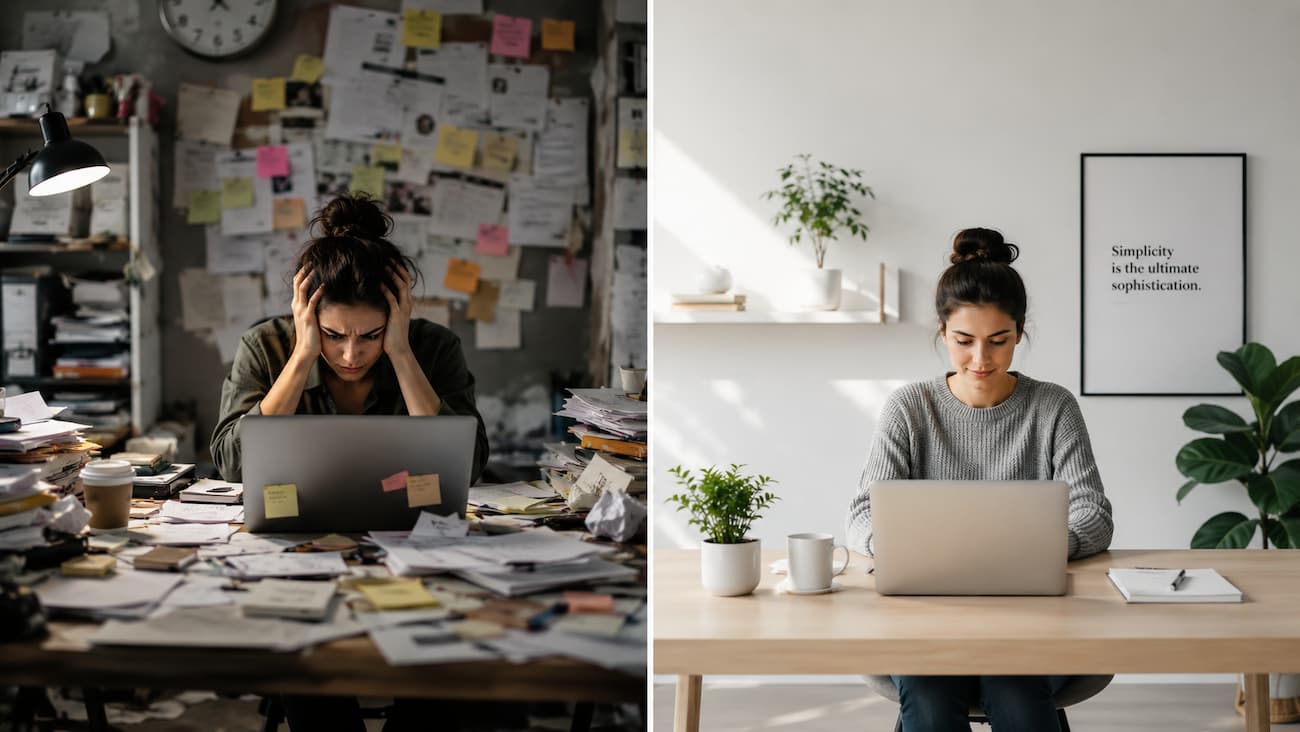
Your work environment is equally powerful. A study published in the Journal of Neuroscience found that visual clutter competes for your attention, resulting in decreased performance and increased stress. When your desk is piled with papers, sticky notes, and random objects, your brain is constantly processing that visual noise — even when you’re trying to focus on an important task.
Conversely, a clean, organized workspace reduces cognitive load and makes deep work easier. This isn’t about aesthetics for Instagram. It’s about removing friction from your most important tasks. When everything you need is within arm’s reach and nothing unnecessary is in your field of vision, your brain can fully engage with the work that matters.
Clean vs. cluttered workspace: Your physical environment directly impacts your ability to focus and perform at your best.
The Social Environment Factor
Don’t overlook your social environment. The people you spend time with shape your habits in profound ways. Research from the Framingham Heart Study found that if your close friend becomes obese, your own risk of obesity increases by 57%. This isn’t about blame — it’s about how social norms and shared environments influence behavior. Surround yourself with people who embody the habits you want, and you’ll find those habits become significantly easier to maintain.
How to Design Your Environment for Better Habits
Now that you understand why environment matters more than motivation, let’s get practical. Here are actionable strategies you can implement today:
1. The “Path of Least Resistance” Principle
Every habit has friction. Your goal is to reduce friction for good habits and increase friction for bad ones. Want to watch less TV? Unplug it and put the remote in a drawer. Want to exercise more? Sleep in your workout clothes and place your shoes next to your bed. The easier you make the desired behavior, the more likely you are to do it — regardless of how motivated you feel.
2. Create Visual Cues
Your brain responds to visual triggers. Use this to your advantage:
- Place your vitamins next to your coffee maker so you see them every morning
- Put a yoga mat in your living room where you’ll trip over it
- Keep a book on your nightstand instead of your phone
- Display healthy recipes on your refrigerator door
3. Design Your Digital Environment
Your phone and computer are environments too. Remove social media apps from your home screen. Use website blockers during work hours. Turn off all non-essential notifications. Your digital space should support your goals, not sabotage them. Every app icon is a potential distraction — curate your home screen like you’re curating a museum.
4. The “One In, One Out” Rule
Clutter accumulates because we bring things in faster than we remove them. Adopt a strict one-in, one-out policy: for every new item you bring into a space, one old item must leave. This applies to clothes, kitchen gadgets, books, and digital files. A lean environment is a focused environment.
An organized pantry with clear containers and labeled sections makes healthy eating effortless and visually appealing.
Key Takeaways: Environment Design Checklist
- Make good habits obvious by placing visual cues in your path
- Make good habits easy by reducing friction and steps required
- Make bad habits invisible by removing cues and increasing friction
- Make bad habits difficult by adding steps between you and the undesired behavior
- Audit your spaces monthly — environments drift back toward chaos if left unchecked
Environment Design for Parents and Families
If you’re a parent, you already know that willpower is a limited resource that gets depleted by 9:00 AM. The good news? You can design your home environment to parent for you. When your space is set up correctly, good behavior becomes the default for your kids too.
Start with the “yes space” concept: create areas where children are free to explore without constant correction. Low shelves with age-appropriate toys, accessible healthy snacks in bottom fridge drawers, and hooks at kid-height for backpacks and coats all reduce daily power struggles. When the environment supports independence, you spend less energy enforcing rules.
Mealtime is another prime opportunity for environment design. Serve vegetables first, before other foods hit the plate. Use smaller plates — research shows people eat less without feeling deprived. Keep screens out of the dining area entirely. These environmental tweaks create family habits that don’t require daily negotiations.
Bedtime routines benefit enormously from environmental consistency. Dim the lights 30 minutes before bed. Keep screens out of bedrooms. Use the same calming music or white noise each night. When the environment signals “sleep time” consistently, children’s bodies learn to respond — no matter how much they protest. A calm, organized family breakfast routine sets the tone for the entire day and reduces morning chaos.
Environment Design for Professionals
For working professionals, environment design is a career superpower. Your workspace should be optimized for your specific type of work. If you do creative work, surround yourself with inspiring visuals and natural elements. If you do analytical work, minimize visual distractions and use noise-canceling headphones.
The “two-minute rule” applies here: if a task takes less than two minutes, your environment should make it impossible to avoid. Keep a trash can within arm’s reach. Place a notepad on your desk for quick idea capture. Set up automatic bill pay so financial tasks don’t pile up. These micro-design choices compound into massive productivity gains over time.
Consider your commute environment too. If you drive, use that time for podcasts or audiobooks that support your professional growth. If you take public transit, download reading materials in advance so you’re not scrolling social media by default. Even transitional spaces can be designed for improvement. A minimalist, organized desk setup eliminates visual distractions and creates mental space for deep, focused work.
Common Environment Design Mistakes to Avoid
Even with the best intentions, people often make these environment design errors:
- Trying to change everything at once. Overhauling your entire home or workspace in a weekend creates decision fatigue and burnout. Start with one room, or even one corner. Small, sustainable changes beat dramatic overhauls.
- Designing for the ideal version of yourself. Be honest about your actual behavior, not your aspirational self. If you never use that fancy juicer, donate it. Design for who you are today, with gentle nudges toward who you want to become.
- Ignoring maintenance. Environments naturally trend toward disorder (hello, entropy). Schedule monthly 15-minute resets for each space. Without maintenance, even the best-designed environment will revert to chaos.
- Neglecting digital spaces. Your physical environment is only half the battle. An organized desk means nothing if your phone buzzes every three minutes. Apply the same intentionality to your digital life.
- Copying someone else’s setup. What works for a minimalist YouTuber might not work for a parent of three. Your environment must reflect your actual life, goals, and constraints. Personalization is essential.
A thoughtfully organized home office with designated spaces for different activities supports both productivity and work-life balance.
FAQs
Q: How long does it take for environment changes to affect my habits?
A: You’ll notice immediate effects for simple behaviors (like eating more fruit when it’s visible), but lasting habit change typically takes 2-8 weeks of consistent environmental cues. The key is maintaining the environment design long enough for your brain to form new automatic associations.
Q: What if I share my space with people who don’t care about organization?
A: Focus on the spaces you control completely first — your side of the bedroom, your desk, your car. As others see the benefits of your organized spaces, they often become more receptive. Start with “I” statements: “I feel calmer when the kitchen counter is clear” rather than “You need to clean up.”
Q: Can environment design really replace motivation entirely?
A: Environment design doesn’t eliminate the need for motivation, but it dramatically reduces how much motivation you need. Think of it this way: motivation gets you started, but environment keeps you going when motivation inevitably fades. You need both, but environment is the more reliable partner.
Conclusion: Start With Your Space, Not Your Willpower
Here’s the bottom line: You don’t have a motivation problem. You have an environment problem. And that’s actually great news, because while motivation is fickle and hard to control, your environment is something you can design, adjust, and optimize.
Start small. Pick one space — your desk, your kitchen counter, your nightstand — and redesign it to support one specific habit you want to build. Remove one source of friction. Add one visual cue. Make one bad habit slightly harder to do. These tiny environmental tweaks create outsized results because they work with your brain’s natural tendencies rather than against them. Motivation will come and go like the weather. But a well-designed environment? That’s your foundation. That’s your insurance policy. That’s the difference between people who try to change and people who actually do. So stop waiting to “feel motivated.” Start redesigning your world instead. Your future self will thank you.

Abdur Rahman is a writer and digital learning enthusiast focused on critical thinking, self-improvement, productivity, and practical online learning strategies. He shares experience-based articles that help readers build useful habits, improve digital skills, evaluate information more effectively, and develop smarter learning systems for everyday life. Through Knowledge Source Hub, his goal is to make learning simpler, more practical, and accessible for everyone.