
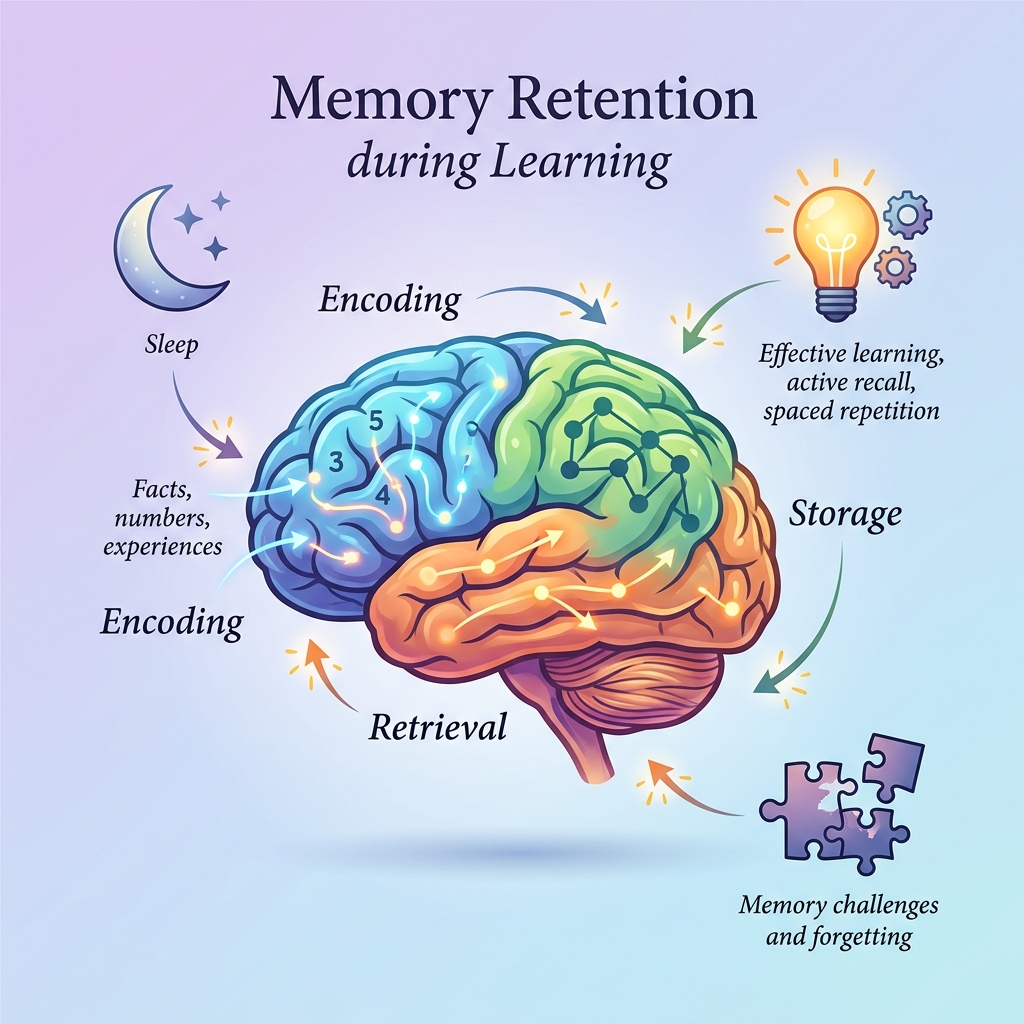
Before mastering a new skill, it is crucial to understand how the brain stores and retrieves knowledge. Deep within the brain, complex neural processes take place when people read a book, attend a lecture, or play a musical instrument. Memory is not simply a passive record of events. Experiences and environmental stimuli actually prompt the brain to actively build, organise, and reconstruct knowledge.
To learn effectively, you must understand how the biological mechanisms behind memory work. When professionals or students experience memory problems, it is often during one of the crucial phases of memory processing. People can better utilise the brain’s natural capacity by understanding how fleeting thoughts are converted into lasting knowledge.
For decades, scientists have been mapping the complex pathways that determine how well we remember things. Memory is controlled by a complex network of multiple brain regions, such as the hippocampus and the prefrontal cortex, which work together effectively. By following these pathways, we can understand why some facts stick in our memory forever, while others disappear instantly.
The First Step in Memory is Encoding
When new knowledge enters the brain, encoding is the first task. When someone focuses on a stimulus, the brain converts sensory information into a form (chemical and electrical signals) that neurones can understand. If someone does not pay enough attention to this information, it cannot be stored correctly and therefore cannot be recalled later.
The brain processes external information primarily through three encoding methods: auditory, visual, and semantic. Semantic encoding usually yields the best memory retention, meaning that knowledge is given meaning and context. The brain builds stronger neural connections when people learn new knowledge by associating it with existing knowledge.
Storage: The Abode of Memory
After information has been encoded, the brain must store it for later use. The memory system stores information in phases: first sensory memory, then short-term memory, and finally long-term memory. Short-term memory is like a temporary storage space, which can only hold a small amount of information at a time and lasts less than a minute. To store knowledge long-term, the brain must undergo physical changes known as memory consolidation. When neural networks consolidate,they strengthen their synaptic connections, which allows them to store informationd in the cerebral cortex. This vast storage network has virtually unlimited space, enabling people to retain memories, facts, and complex skills for a lifetime.
Retrieving Stored Information (Retrieval)
People can bring stored information back into their consciousness through a process called retrieval. The effectiveness of this process depends largely on the brain’s ability to organise and process information. When you correctly link a memory to the right signals, recalling it feels effortless and fast.
Sometimes the brain struggles to retrieve stored information, which can feel like a word is on the tip of your tongue, but you cannot pronounce it. This usually means there is a problem with the retrieval pathway, rather than memory loss. Over time, active memories strengthen these connections, making future retrieval faster and more reliable.
How Sleep Helps You Remember Things
Sleep is biologically essential for consolidating new knowledge. During deep sleep cycles, the brain replays neural processes that took place during the day. This transfers memories from the hippocampus (where short-term memory is more easily stored temporarily) to the cerebral cortex (where long-term memory is more easily stored permanently). If you do not obtain enough sleep, this information transfer process stops, which can lead to serious problems with thinking and memory.
Researchers have discovered that both deep sleep (slow-wave sleep) and REM sleep are critical to sustaining different types of memory. Prolonged deep sleep can significantly improve declarative memory, such as facts and words. On the other hand, REM sleep optimally improves procedural memory.
Factors Influencing Memory
The brain’s ability to retain new information depends on many internal and external factors. The emotional state is crucial, as fear releases cortisol, a chemical that damages the hippocampus and impairs memory. Conversely, moderate emotional involvement can promote memory by giving the brain the message “Knowledge is important.”
Nutrition, physical exercise, and the overall environment also have a significant influence on cognitive abilities. Regular cardiovascular exercise improves blood circulation to the brain, promotes the growth of new neurones, and makes synapses more flexible. A quiet, undisturbed environment allows the brain to focus on storing the information.
Methods to Improve Memory and Learning Ability
People can remember difficult things better by using scientifically proven methods. Spaced repetition prevents the brain from forgetting things on its own by gradually increasing the intervals between memory sessions. This method is much more effective than cramming at the last minute, which only temporarily improves short-term memory and cannot build lasting neural connections.
Combining different subjects or courses within the same study period, also known as interleaved learning, forces the brain to work harder and builds stronger connections. Furthermore, mnemonics and self-tests can create strong memory aids. Students no longer passively read text but build strong cognitive frameworks by constantly challenging their minds.
Common Memory Problems and their Solutions
Everyone forgets things occasionally or struggles to understand new concepts. These problems often occur when students try to absorb too much knowledge at once, a phenomenon known as cognitive overload. Breaking down complex concepts into smaller, more manageable parts prevents the overloading of working memory and thus slowness. Another major problem is interference, where old memories hinder the formation of new memories, or new memories interfere with old ones. To avoid distraction, students should regularly interrupt their study sessions and avoid studying very similar subjects back-to-back. Creating clear, independent contexts for different subjects helps the brain organise information and find the information needed.
How Memory Changes Over Time
Cognitive skills naturally change as we become older. The brains of young children are incredibly flexible, allowing them to learn languages and basic skills at an astonishing pace. The brain processes information fastest and most efficiently during adolescence.
Older adults may notice their memory is less sharp and that they learn new things more slowly. However, older adults generally have better semantic memory and store a large amount of consolidated information. Lifelong learning and engaging in mental activities help maintain brain health and slow down age-related memory decline.
Unleash your Brain’s Potential
Understanding how memory works allows you to take control of your academic and professional development. Everyone can improve their learning behaviour and acquire more knowledge by understanding the three key steps of encoding, storing, and retrieving. When you prioritise good habits, active participation, and strategic practice, learning becomes an easy and enjoyable process. As soon as you start spaced repetition and ensure you get enough sleep, you will notice that your thinking ability and memory improve every day.
Frequently Asked Questions
1. What are the key steps of memory?
The key steps of memory are registering, storing, and retrieving. Sensory input is encoded into a usable format; data is stored to ensure long-term safety, and information is retrieved when needed.
2. What influence does stress have on memory and learning?
Under excessive stress, the brain produces the hormone cortisol. Cortisol damages the hippocampus, making it more difficult for the brain to form new memories. Chronic stress significantly increases the difficulty of storing and retrieving knowledge.
3. Why is active recall better than repeatedly reading notes?
Active recall enables the brain to autonomously search for and retrieve information, thereby strengthening neural connections and making long-term memories more stable. Repeated reading is a passive exercise; although it might make you feel smart, it does not build strong memory connections.
4. Does exercise help with memory?
Yes, exercise provides more oxygen and blood flow to the brain, allowing new neurones to survive better. Regular aerobic exercise helps change the hippocampus, a crucial part of the brain responsible for memory.
5. How do you prevent overloading your brain?
Breaking down information into easy-to-understand chunks is the best way to prevent overloading your brain. By taking regular breaks and focusing on one idea at a time, you can prevent overloading your short-term memory.

Abdur Rahman is a writer and digital learning enthusiast focused on critical thinking, self-improvement, productivity, and practical online learning strategies. He shares experience-based articles that help readers build useful habits, improve digital skills, evaluate information more effectively, and develop smarter learning systems for everyday life. Through Knowledge Source Hub, his goal is to make learning simpler, more practical, and accessible for everyone.